What is Answer Engine Optimization?
Answer Engine Optimization (AEO) is the practice of earning presence for a brand inside AI-generated answers: the responses ChatGPT, Gemini, Perplexity and Google AI compose when buyers ask what to buy, use or trust. Where classic SEO competes for position on a ranked results page, AEO competes for inclusion in an answer that names only a handful of options and cites only a handful of sources.
The sibling term you will meet immediately is Generative Engine Optimisation (GEO). In practice the labels describe overlapping work aimed at the same surfaces, GEO leaning slightly toward Google's generated results and AEO toward the assistant engines, and the vocabulary has not settled. This guide uses AEO throughout and treats the discipline as one thing: the work of becoming easy for answer engines to find, parse, corroborate and name.
Two properties make the discipline unlike the search marketing it grew out of. There is no page two: a buyer who asks an assistant for a shortlist sees three to five names, and every other brand in the category is functionally invisible for that question. And the answer itself is not for sale: OpenAI, launching ads in ChatGPT, stated plainly that ads do not influence the answers and that advertisers cannot shape, rank or alter responses. Presence in the answer is earned or absent.
Why does AEO exist now?
Because the demand curve says so, in numbers we pulled ourselves. From DataForSEO's US Google keyword database (August 2026), average monthly searches by year:
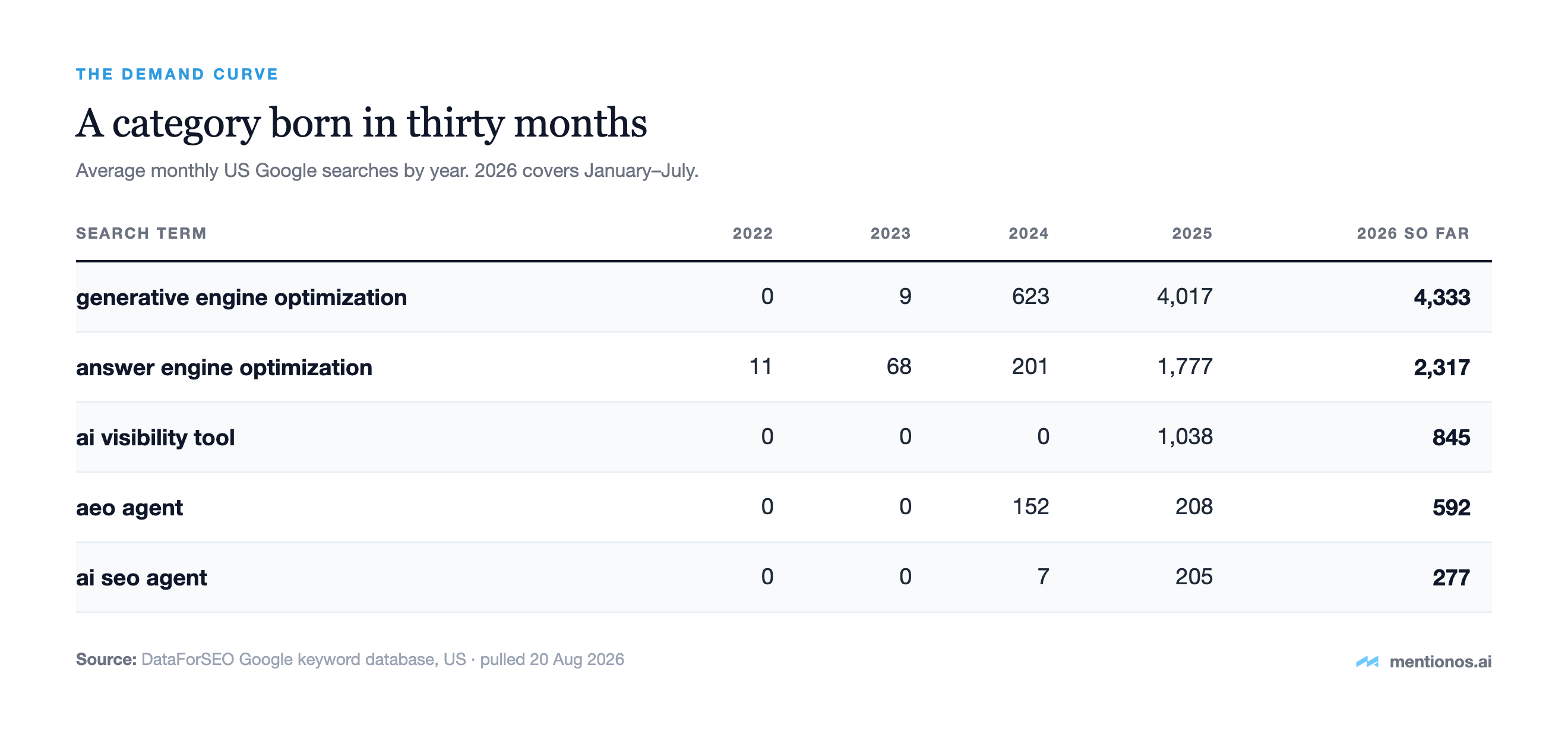
A discipline whose head term went from 9 to over 4,000 monthly searches in twenty-four months is a discipline being born in public. The commercial signal is sharper still: Google's ad auction prices clicks on "aeo agent" near fifty dollars and "answer engine optimization" near thirty-one, and advertisers do not pay those rates for curiosity. The buyers behind the curve are marketers arming themselves to contest categories, which is exactly why brands outside the vocabulary still cannot sit this out: their categories' answers get contested either way.
The underlying behaviour shift is the part that will not reverse. Buyers increasingly begin with a question to an assistant instead of a query to a results page, the answer arrives with brands already chosen, and with OpenAI's Instant Checkout the distance from named to purchased has reached zero clicks for participating merchants.
How do AI engines choose what an answer says?
Two pools: training and retrieval
Every answer draws on some blend of what the model absorbed during training and what its retrieval system fetches at question time. Training knowledge is slow-moving and impossible to edit directly; retrieval is fast-moving and responds to the live web. The practical asymmetry matters for planning: work you ship shows up in retrieval-backed answers first, sometimes in weeks, while training-pool changes arrive on the timescale of model updates. Nothing about either pool consults a ranked results page before naming brands, which is why a strong Google position does not transfer automatically, a gap we measured and documented in why your Google rank means nothing to ChatGPT.
Where the citations come from
Engines corroborate before they name, and the corroboration leans heavily on third-party ground: review platforms, comparison pages, community threads, industry publications, with a brand's own site as one voice among many. We measured a version of this directly in August 2026: every core question in our own category triggered a Google AI Overview, and the recurring cited domains were Reddit, YouTube, HubSpot, Coursera and Forbes, generalists holding the citation slots of a young category by default. The strategic reading: the sources engines already trust are a map of where your brand needs to appear, and displacement of default incumbents by genuine specialists is how young categories settle.
Entities: the identity layer
Underneath sources sits identity. Engines resolve brands into entities, assembled from every mention they can parse, and a brand whose name, facts and claims agree everywhere is cheap to corroborate, while a fragmented identity is expensive and gets skipped. Google's own guidance points the same direction from the search side: structured data gives explicit clues about page entities without being a ranking guarantee, and clear, consistent authorship and sourcing support trust. Entity work is unglamorous, and it compounds.
How is AEO different from SEO?
The honest answer is a shared foundation with a different contest on top. What transfers: technical accessibility, because answer systems can only use content they can find, crawl, parse and understand, exactly as Google's own developer guidance states for search; content quality, because Google's people-first standard, original information, first-hand experience, and evidence over commodity summaries, is precisely what generative surfaces reward too; and the audience a ranking earns, whose coverage and discussion become the third-party corroboration answers lean on.
What does not transfer is position itself. Ranking is an ordered list; answering is a composition. SEO's currency is the click from position; AEO's currency is the name inside the response, often with no click at all. The disciplines also measure differently, share of ranked positions versus share of answer presence, and they fail differently: an SEO failure is page two, visible in every rank tracker, while an AEO failure is silence no analytics dashboard records. Run both; they are one budget with two outputs. The deeper mechanics get their own guide in this series.
What are the five workstreams of AEO?
Question intelligence
The raw material is what buyers ask, phrased as buyers phrase it, from concept questions down to "best", "worth it" and "alternative" variants. The evidence standard belongs here from day one: first-party query data and the live result landscape, before choosing any deliverable, because forcing every finding into an article is how content farms are born.
Content built to be lifted
Answer-shaped content states the question as a heading and the complete answer in the first two sentences beneath it, with evidence attached and dates visible. Two Google positions frame the craft honestly: AI-assisted content is not disallowed for being AI-assisted, and producing many unoriginal pages primarily to manipulate search or generative answers is scaled-content abuse however it was produced. The bar is original information and genuine usefulness; volume without it is now a named spam policy.
Entity and third-party presence
The workstream classic marketing forgot: review-platform profiles, comparison presence, community participation, consistent brand facts everywhere the engines read. This is where the citation map from the previous chapter becomes a work list.
Technical readability
The floor everything stands on, and the workstream with the clearest official guidance. Server-render or pre-render what matters, because not every search or AI crawler executes JavaScript. Know that robots.txt controls crawling and is unreliable for index removal, and that a noindex only works where the crawler can fetch it. Align canonical signals and redirects rather than letting them argue. Keep Core Web Vitals inside Google's published good-experience thresholds: largest paint within 2.5 seconds, interaction under 200 milliseconds, layout shift below 0.1. Mark up structured data validly for what is visibly on the page. None of it guarantees a citation; all of it decides eligibility.
Measurement
Read the answers themselves, on a schedule, across the engines your buyers use, and read them beside first-party data. Google Search Console supplies impressions, clicks and queries with known blind spots, anonymised queries make its tables incomplete, so treat missing rows as missing, never as zero demand. Analytics ties visibility to business outcomes, with the standing caveat that attribution settings decide how credit lands and one last-click report proves little alone. Third-party tool metrics are modelled estimates, valuable and labelled as such, never Google's internal truth.
Who does the AEO work?
The five workstreams are continuous, evidence-hungry labour, and every brand answers one question before choosing tools: whose hands. In-house works where a capable marketer has real hours. Analytics platforms serve teams that convert findings into shipped work as routine; the category's products are compared honestly, ours included, in the best rated AEO tools. Agencies sell the labour with judgement attached, and the questions that separate a strong one from a weak one are set out in our agency hiring guide. The agent form performs the work itself under human approval; MentionOS is that form, the operating Agent for AEO, reading ChatGPT, Claude, Gemini, Google AI and Perplexity continuously, shipping content and fixes to your own site on your approval, with a receipt for every action. The full map of the buying options sits in answer engine optimization services.
How do you start this week?
The first afternoon needs no budget. Write down the ten to fifteen questions your buyers would ask an assistant, in their words. Put each to ChatGPT, Gemini and Perplexity; record which brands get named and which sources each answer cites. Check whether Google shows an AI Overview for the same questions and note who it cites. What comes back is your category's true scoreboard: where you are named, where you are absent, and the specific sources doing the deciding.
The document tells you your next month. Absent from answers that cite review platforms: your entity workstream starts there. Absent where a competitor's comparison page is the cited source: that is a content brief with a deadline. Named but mischaracterised: your brand-fact consistency needs the pass first. Repeat the reading monthly and the drift becomes visible; the drift is the strategy. The working method in full detail is in how to get ChatGPT to recommend your brand, and the audit process is getting its own step-by-step guide in this series.
Frequently asked questions
What is AEO in simple terms?
AEO is the work of getting your brand named when AI assistants answer your buyers' questions. Assistants compose short answers that mention a few brands and cite a few sources; AEO makes your brand findable, checkable and worth naming in that process.
Is AEO replacing SEO?
The demand data says addition, and the replacement question misreads the mechanics. Search demand for AEO's own vocabulary grew from near zero in 2022 to thousands of monthly searches in 2026 while SEO's base remains far larger; buyers now split their journeys across both surfaces, and the disciplines share a technical foundation. Brands need presence in ranked results and inside answers at once.
What is an example of answer engine optimization?
A brand notices ChatGPT recommending competitors for "best [category] for [situation]" and citing a comparison site where it has no presence. It earns a listing there, publishes its own page answering that exact question with evidence and a dated, structured layout, aligns its product facts across its site and profiles, then re-checks the answers weekly until the naming changes. Every part of that loop is AEO.
How long does AEO take to work?
Honest answer: no fixed timeline exists, and anyone quoting one is guessing. Retrieval-backed answers can reflect new, well-corroborated content within weeks; training-pool presence moves on model-update timescales. The variables that matter are how contested your category's questions are, how quickly your work earns third-party corroboration, and whether the reading-and-responding loop runs continuously or in bursts.
Can you do AEO yourself without tools?
The first pass, absolutely: the afternoon audit above requires only the engines themselves. Sustained AEO is harder to hand-run, because answers drift constantly and manual checking is the first casualty of a busy month. Whether the continuation is a tool, an agency or an agent is a capacity decision, mapped in answer engine optimization services.