Why did skincare buying move into AI conversations?
A skincare purchase was never one question. A buyer carries a skin type, two or three concerns, a sensitivity history, a budget, and a shelf of products that mustn't clash. No results page answers all of that together. A chat assistant holds the whole picture and answers with a routine, brand names included.
The demand shows up in our August 2026 keyword pull. US searches for "ai skin analysis" run around 880 a month. "Best skincare brands" runs around 4,400. And the buyers who ask ChatGPT directly never register in either number.
The stakes are the same as every category in the complete AEO guide: when the assistant composes the shortlist, an unnamed brand loses the sale before any site visit happens. What makes beauty different is how the engines decide who gets named. We measured that from both ends, and this guide is the result.
What do skincare buyers ask the engines?
The buying questions take a clinical accent in beauty. The phrasing below comes straight from live People-Also-Ask boxes in our August 2026 Google pull.
- Category-open: "what are the best skincare brands", and the variant that appeared under four different queries in our pull, "what is the No. 1 brand recommended by dermatologists?"
- Situation-scoped: best brands for anti-aging, for acne-prone skin, for sensitive skin
- Validation: "is expensive skincare worth it", "do expensive skin products actually work"
- Safety: "how to check if a skincare product is legit"
- Comparative: medical-grade against drugstore, clean beauty against conventional
- Routine-instructional: "build me a skincare routine for combination skin", where brands get named step by step as the answer assembles itself
Notice what that recurring dermatologist question is telling you. Skincare buyers aren't asking who advertises best. They're asking who a clinician would pick, and as the measurements below show, the engines answer in exactly those terms.
Who holds the trust slots on Google? We measured.
We ran the Google half of the audit method on all twelve buying questions in US Google, August 2026. What came back:
- An AI Overview appeared on every single question, twelve of twelve. That's the heaviest generative coverage we've measured in any category so far.
- Reddit placed top-five on eleven of the twelve questions, first on several.
- Retailers hold advice slots: Ulta placed top-five four times, Dermstore three, with Sephora, CVS and Macy's behind them.
- Clinical surfaces hold slots too: Mayo Clinic, the American Academy of Dermatology, and a spread of individual dermatology clinic sites.
- Beauty press holds the rest: Byrdie, WhoWhatWear, InStyle, the New York Times.
- Brand-owned pages rank directly. La Roche-Posay's own site placed first on two queries. CeraVe's site made a top five.
That last point changes the job. In travel we measured operators locked out of the advice layer entirely; they only surfaced when someone else talked about them. In beauty the door is open. A brand's own answer-shaped page can hold a trust slot itself.
Which brands do the engines name? We asked all four.
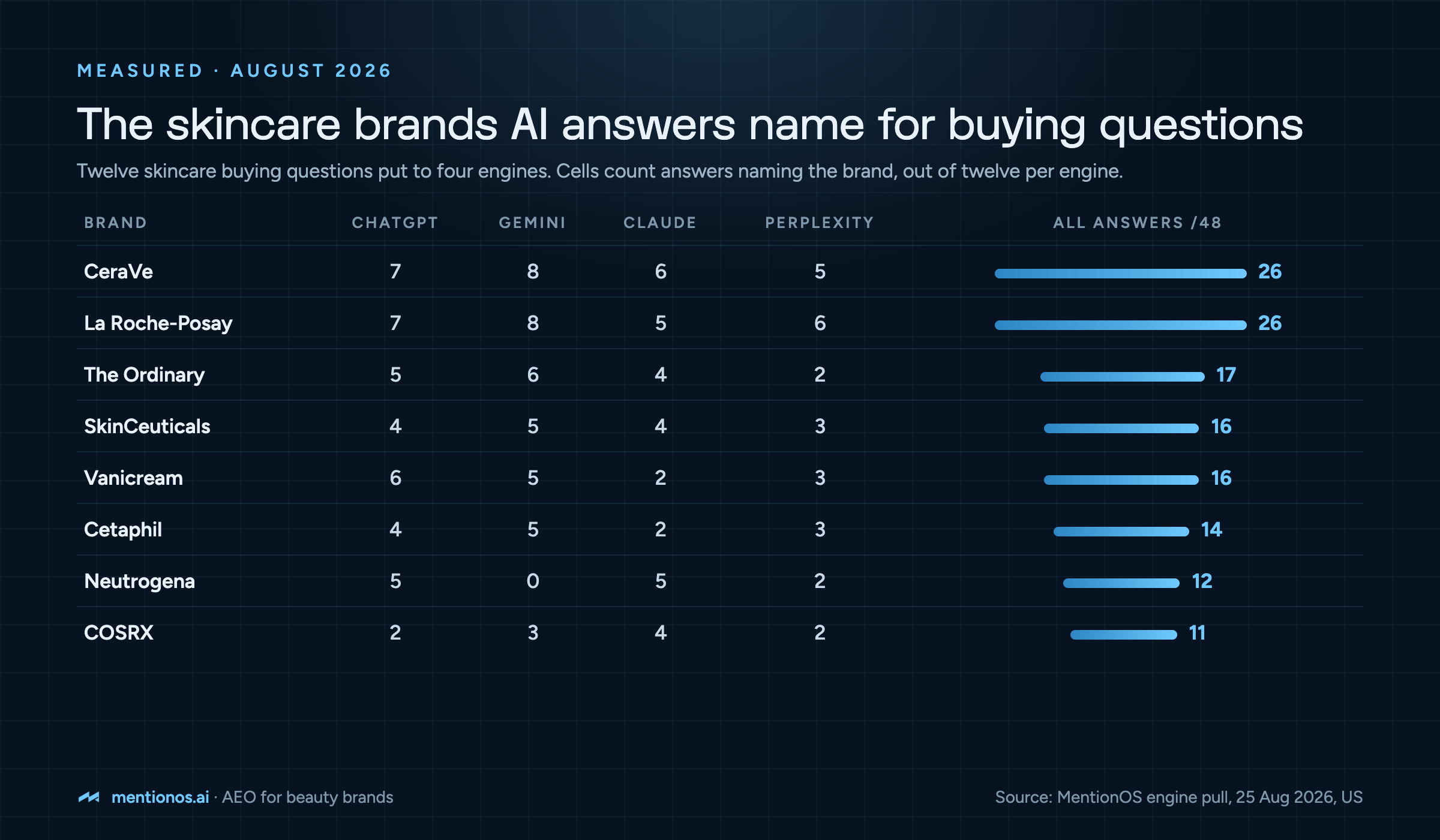
Then we asked the engines themselves. In August 2026 we put the same twelve questions to ChatGPT, Gemini, Claude and Perplexity and counted every brand across the 48 answers. The twelve, word for word:
- what are the best skincare brands
- best skincare brands for anti aging
- best skincare for acne prone skin
- best skincare brands for sensitive skin
- is expensive skincare worth it
- is medical grade skincare better than drugstore skincare
- are clean beauty products better for your skin
- best korean skincare brands
- what skincare brands do dermatologists recommend
- build me a skincare routine for combination skin, which brands should i use
- how can i tell if a skincare brand is safe and legitimate
- best drugstore skincare brands
Five things stood out.
Two pharmacy brands tie for the whole category. CeraVe and La Roche-Posay each came up in 26 of the 48 answers, and every engine named both repeatedly. Behind them: The Ordinary (17), SkinCeuticals (16), Vanicream (16), Cetaphil (14), Neutrogena (12), COSRX (11), then a tail of more than fifty brands named once or twice.
The dermatologist question shows how the whole thing works. Asked what brands dermatologists recommend, all four engines converged on the same short list: CeraVe, La Roche-Posay, SkinCeuticals, Vanicream, Cetaphil, EltaMD. It was the tightest cross-engine agreement in our pull. The engines have absorbed years of clinicians repeating the same names, and those names now come out as the default answer.
Below the leaders, the engines stop agreeing. Neutrogena was named five times each by ChatGPT and Claude, and zero times by Gemini. If you're reading your visibility off one engine, you're reading a quarter of the market.
Korean skincare runs as its own league. The K-beauty question produced a different brand set entirely (COSRX, Beauty of Joseon, Anua, Torriden, Round Lab, Skin1004), and all four engines broadly agreed on it. A strong category-of-origin story can build its own answer league beside the incumbents.
Where medical stakes rise, brands vanish. Asked for the best acne skincare, ChatGPT, Claude and Perplexity named ingredients (salicylic acid, benzoyl peroxide, niacinamide, azelaic acid) and no brands at all. Only Gemini named products. The brand that wins the hard skin questions is the one whose products already serve as the standard example for an ingredient.
The questions no brand owns yet
The doubt questions came back close to brand-empty:
- "Is expensive skincare worth it": zero brand names from three of the four engines.
- "Are clean beauty products better for your skin": zero from all four, and the answers questioned the label itself as unregulated marketing language.
- The safety question, covered next: zero from all four.
These are the conversations where a buyer decides what kind of purchase to make before picking a product, and right now they run without brands in them. A brand whose honest content becomes source material there (a genuine cost-per-use comparison, a formulator explaining what the premium price buys) is competing for empty ground. The league table above is a fought market. The doubt conversations aren't.
How do the engines answer the safety question?
Asked how to tell whether a skincare brand is safe and legitimate, no engine named a single brand. All four described the same verification procedure instead:
- Check FDA registration and recall history
- Read the full INCI ingredient list
- Watch for counterfeit product, and buy through authorized retail channels (Sephora and Ulta came up as the reference examples)
- Screen ingredients through sources like EWG
Every item on that list is something a machine can check, which makes it a publishable checklist for a brand. Full INCI lists on every product page, in crawlable text. Authorized-retailer lists stated plainly on your own site. A clean, findable regulatory footprint. The same brand and product names everywhere a buyer or an engine might verify them. Do that and the category's scariest question is answered before anyone asks it.
Where do the answer citations point?
- Perplexity grounded all twelve of its answers and cited Reddit in nine of them.
- Gemini grounded eleven of twelve, and its resolved citation trail leads somewhere new: YouTube was its most-cited source in beauty, ahead of Reddit. Video reviews and routine tutorials are doing retrieval work in this category.
- ChatGPT cited the American Academy of Dermatology in four separate answers. Clinical authority reaches the answer layer directly.
- The rest of the pool: beauty press (WhoWhatWear showed up in eight answers' citations), retailers (Dermstore, Ulta, Sephora), health publishers, and brands' own sites.
- ChatGPT and Claude answered four and five questions respectively from model memory, with no live sources. What's already in the training data (the old threads, the durable writeups) matters as much as what gets fetched live.
What does all of this mean for a beauty brand?
Strip the numbers away and the map is short. The engines name the skincare brands that clinicians keep recommending, that communities and reviews back up, that video covers, and whose own pages answer questions plainly. Beauty is unusual on two counts: your own site can hold trust slots directly, and the doubt conversations are still empty. The rest of this guide is that work, in order.
How does a beauty brand enter the answer?
Professional corroboration first
The dermatologist question sits at the centre of this category, so clinical voices are the first surface worth earning: dermatologists discussing your formulations, clinician-created content that mentions your products on merit, presence on the clinic-adjacent surfaces the engines already cite. This compounds slowly and can't be bought quickly, which is exactly what makes it hard for competitors to take back.
Communities, reviews and retail
Reddit's skincare threads decide reputations, and the engines read them as evidence. Retailer reviews matter twice over: honest, recent reviews at Ulta and Sephora feed the same retail domains that hold both search slots and answer citations in our data. Recency counts as much as volume.
Video, because Gemini is watching it
With YouTube at the top of Gemini's citation trail, tutorial and review coverage of your products is retrieval material, whether you made the video or a creator did. Beauty is the category where a video review does answer-layer work.
Your own pages, because in beauty they rank
Beauty is the category where brand sites hold advice slots directly. Answer-shaped pages on your own domain can rank, get cited and get lifted, so on-site work pays twice here.
What should a beauty brand publish?
- Full INCI lists with plain-language explanations of what each active does, because the engines answer hard skin questions in chemistry and cite whatever makes the chemistry legible
- Routine pages by skin type and concern, because the routine question pulled more brand names per answer than any other in our pull: engines name a brand per step, and pages that map products to steps hand the engine its answer structure
- The honest-doubt pieces the empty ground is waiting for: a genuine drugstore-against-premium comparison, what a higher price does and doesn't buy, who a product doesn't suit
- Visible dates and a reformulation-checked refresh pass, because formulations change and a discontinued product strands every page citing it, per the honest-dating guidance in how AEO works
The technical layer
The platform rules from the general guides apply here with a retail accent. Server-render everything that answers a question. Product and organisation structured data on every product page. An llms.txt stating brand facts directly. And one discipline specific to beauty: the same product must carry the same name on your site, at every retailer and in every review destination, because a product that goes by three names splits its evidence three ways. The full pass is in the AEO audit guide.
Running the loop on beauty's clock
Beauty answers move on launch cycles and ingredient trends, faster than travel's seasonal rhythm. A viral ingredient can re-sort a category's answers in weeks. A reformulation can quietly strand every page citing the old formula. The cadence that works: a full question-set audit quarterly, monthly reads of the dermatologist, validation and category questions, and content refreshed the moment a formulation or lineup changes.
That reading-and-responding loop is continuous work, and it's the loop MentionOS runs as the operating Agent for AEO: it reads what the engines say about your brand and category, ships approved fixes and content to your own site, and reports the movement, for beauty brands that don't have a team to hand it to.
Frequently asked questions
How do skincare brands get recommended by ChatGPT?
Through corroboration in the places its answers draw on: clinician commentary, community threads, retailer review bases, video coverage and answer-shaped pages on the brand's own site. In our August 2026 pull, the brands ChatGPT named most were the ones dermatologists have repeated for years. The general method is in how to get ChatGPT to recommend your brand.
Do retailers matter for AI answers in beauty?
Yes, measurably. Ulta, Dermstore and Sephora hold both organic advice slots and answer citations in our data, so presence and review depth on the major retail platforms feeds surfaces the engines already trust. Beauty differs from travel here: in travel we measured the big booking platforms absent from the advice layer entirely.
Can an indie beauty brand compete with CeraVe in AI answers?
Head-on, in the general questions, slowly if at all; those defaults are years of clinical corroboration deep. The measured openings are elsewhere: situation-specific questions, the near-empty doubt and value conversations, ingredient-level authority, and category lanes like K-beauty where our pull shows the engines keeping a separate brand league. Small brands win named placement by owning a specific conversation before contesting the general one.
How fast do AI skincare answers change?
Faster than most categories. Launch cycles, viral ingredients and reformulations move the underlying evidence continuously, and the engines follow it. A quarterly full audit with monthly reads of the highest-stakes questions is the practical floor.