Money questions get AI's most careful answers
Ask an engine about sheets or CRMs and it hands you brands. Ask whether you need a business credit card, and something different happens: all four engines answered with liability rules, credit-score mechanics, bookkeeping hygiene and IRS consequences, and not one named a card. FDIC insurance came up in 14 of the 48 finance answers we pulled in August 2026, a regulatory drumbeat no other industry shows. Finance is where the engines are at their most guarded, because the questions carry legal weight and the training data knows it.
That caution reshapes the whole game. In the industries we've measured before this one (travel, beauty, software, fashion, home), the fight was to be named. In finance, half the fight is understanding where naming happens at all, because whole stretches of the conversation run on rules instead of recommendations. We put twelve money questions (small-business and consumer) to ChatGPT, Gemini, Claude and Perplexity, and the same twelve through Google. Here's the terrain.
The ledger wears the crown
Where the engines do recommend, one pattern towers over the rest: accounting software wins the money category. QuickBooks was named in 18 of 48 answers and Xero in 15, ahead of every bank, card and fintech we tracked. They surface far beyond bookkeeping questions: inside the choosing-a-bank answers, the accountant-recommendation answers, the full financial-stack answers.
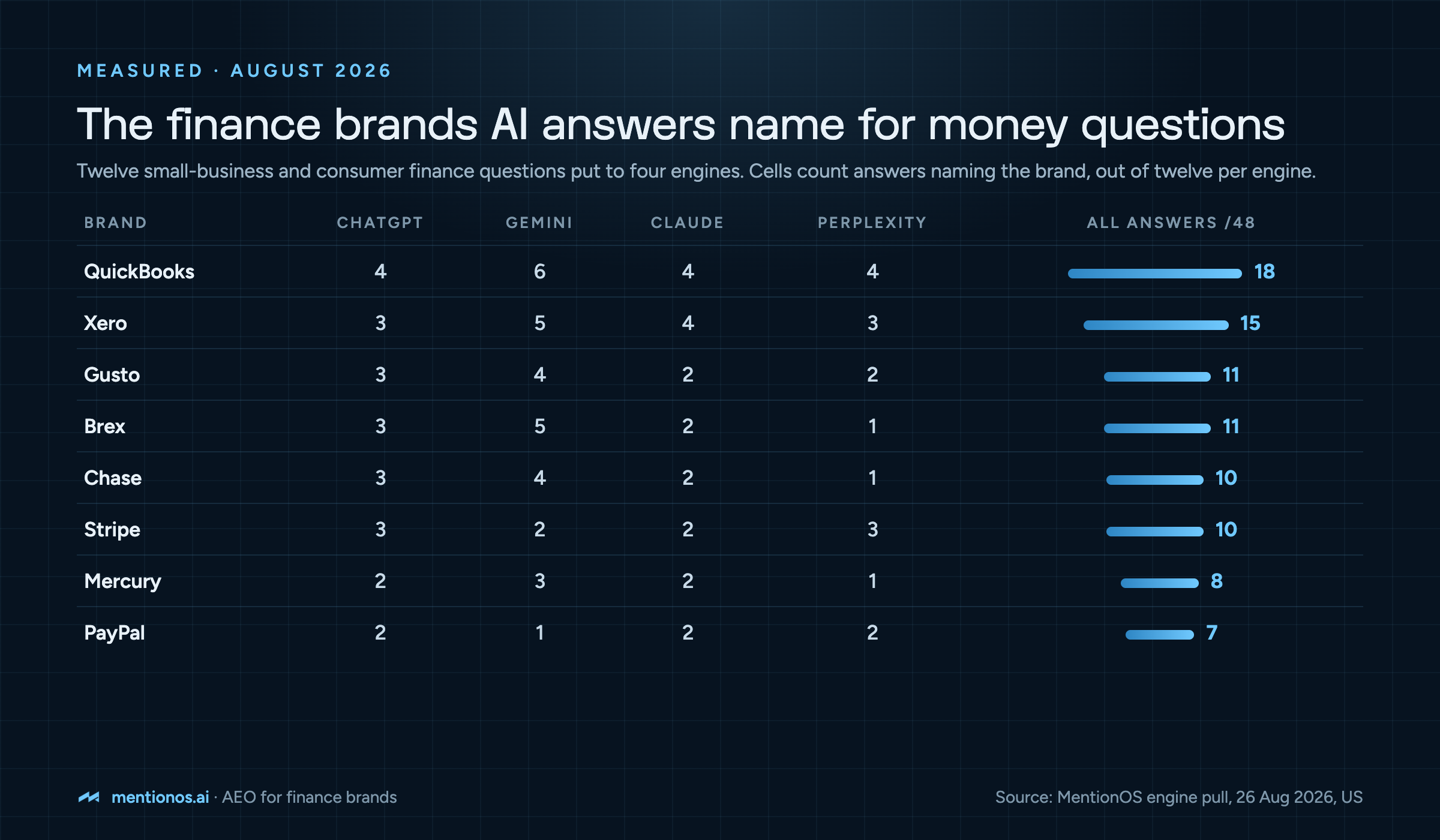
The rest of the league sorts by job. Gusto (11) leads payroll with OnPay, ADP and Rippling behind it. Brex (11), Chase (10) and Mercury (8) split business banking, with the engines disagreeing on the order. Stripe (10) and PayPal (7) own payments, Helcim the budget slot behind them. YNAB and Monarch Money anchor budgeting on every engine. And the stack question ("set up the financial stack for a new small business") assembled all of them: bank, books, payroll, payments, card, each slot filled with a name, QuickBooks or Xero in every engine's version.
The reading for a finance brand: the engines think in jobs, and the ledger is the job every other job connects to. The brands that integrate with the accounting layer get pulled into its gravity; the ones that don't fight for isolated slots.
The twelve questions, exactly as asked: best business bank account for startups; best credit card for small business; best payment processor for small business; best budgeting app; best payroll service for small business; do i need a business credit card or is a personal one fine; are paid budgeting apps worth it; what should i look for when choosing a business bank; how can i tell if a fintech app is safe to use; set up the financial stack for a new small business, what should i use; best high yield savings account; and what financial tools do accountants recommend.
Trust is spelled in acronyms here
Asked how to tell whether a fintech app is safe, the engines recommended almost no companies. They recited a verification liturgy instead: FDIC insurance through a named partner bank, two-factor authentication, encryption, licensing and money-transmitter status, the privacy policy, the app-store review record. One brand kept appearing anyway, and it wasn't a consumer app: Plaid, named by three of the four engines as the connection layer whose presence signals a app is legitimate. Infrastructure has become a trust badge; "connects through Plaid" now does the work a security page used to do.
For a fintech brand the checklist writes itself, and every item is machine-verifiable: state the partner bank and FDIC pass-through in crawlable text, publish the licences, name the infrastructure, keep the security page out from behind the sales form. The high-yield savings question shows what happens when trust signals are all a category has: four engines produced four barely-overlapping lists, because rates change weekly and no durable consensus exists. Where answers are unstable, the freshest verifiable page wins that week's naming.
NerdWallet country
Finance is the first industry we've measured where Reddit does not top the citation table. NerdWallet does, in 14 of the 48 answers' citations, with Forbes at 12, CNBC at 7, and Bankrate strong in Gemini's resolved trail. Reddit still matters (Perplexity cited it in 8 of 12 answers), but the affiliate-comparison press is the layer the engines treat as finance's reference desk, with one more twist: vendor sites themselves get cited (Brex, Mercury, Wise, Ramp, and the banks), and on Google, Mercury and Brex rank top-five for their own buyers' questions the way software vendors do.
Google's half confirms the picture: AI Overviews on all twelve queries, Reddit top-five on eight, NerdWallet on four, and the card networks' own domains ranking on the processor question. Demand runs deep ("best budgeting app" at 5,400 monthly US searches, "ai financial advisor" at 1,900), and one keyword towers over the entire series: "high yield savings account" at roughly 1.2 million searches a month. The money conversation is the largest and most contested answer market there is.
What a finance brand does with this
- Court the comparison press first. NerdWallet, Forbes, Bankrate and CNBC are the citation layer; placement and accuracy there feed the answers more directly than anywhere else we've measured.
- Publish the trust liturgy on your own domain. Partner bank, FDIC terms, licences, 2FA, infrastructure partners, in plain crawlable text. The engines are already reciting the checklist; be the source they lift it from.
- Attach to the ledger. QuickBooks and Xero sit at the centre of the category's gravity. Integrations with the accounting layer, documented on pages engines can read, pull a product into the stack answers.
- Own your job title. The engines recommend by job (payroll, payments, budgeting, banking). A finance product with a crisp one-job identity gets slotted; a diffuse one gets skipped.
- Chase the unstable answers with freshness. Rate-driven questions re-form weekly. Dated, current, verifiable product pages win the categories where no consensus can settle.
- Leave the advice layer alone. The rules-not-brands questions (card-versus-card, do-I-need) are where engines refuse recommendations. Content there earns citations as education, never as pitch, and pitching into it reads exactly as wrong as it is.
Technical baseline as ever (server-rendering, organisation and product schema, llms.txt, one name everywhere): the AEO audit guide has the checklist.
Finance's clock
Finance answers drift on rate changes, regulation and press cycles, at two speeds. The rate-sensitive categories re-form weekly; the trust and stack answers move slowly, on the durable record. That argues for a split cadence: monthly reads of your job-title and comparison questions, immediate updates when your rates, terms or licensing change, and a full audit each quarter.
Running that split-speed watch is the job MentionOS does as the operating Agent for AEO: it reads how the engines describe your product across the money questions, ships the approved fixes and content to your own site, and reports the movement, so a finance brand keeps its answers current at both speeds without building a team for it.
Frequently asked questions
Which finance brands do AI engines recommend most?
In our August 2026 pull, accounting software led everything: QuickBooks in 18 of 48 answers, Xero in 15, then Gusto and Brex (11 each), Chase and Stripe (10). Below the leaders, recommendations sort strictly by job (payroll, payments, budgeting, banking), and the engines disagree on order more than membership.
How do fintech apps earn trust in AI answers?
Through checkable signals: FDIC pass-through via a named partner bank, licences, two-factor authentication, and infrastructure the engines recognise, with Plaid named by three of four engines as the legitimacy marker. Publishing those facts in crawlable text on your own domain matches the exact checklist the engines already recite.
Do comparison sites like NerdWallet matter for AI visibility?
More than anywhere else we've measured. NerdWallet was the single most-cited source in our finance pull, ahead of Reddit, with Forbes, CNBC and Bankrate behind it. Presence and accuracy in the affiliate-comparison layer feeds finance answers the way clinical voices feed beauty's.
How fast do AI finance answers change?
At two speeds. Rate-driven questions (savings accounts, cards) produced four different lists from four engines and re-form continuously; trust and stack answers rest on the durable record and move slowly. Match the cadence to the question type: immediate updates on rate and term changes, quarterly full audits underneath.