Ask an AI to dress you, and it will
In August 2026 we asked ChatGPT to build a capsule wardrobe and name the brands worth buying. It came back with fourteen: Everlane for basics, Uniqlo for layers, Levi's for denim, Quince for cashmere, on down the list. Gemini, Claude and Perplexity ran the same exercise and each produced its own labelled wardrobe. Every one of those answers is a shopping trip some brand never got to compete for.
This is not a niche behaviour waiting to arrive. "Capsule wardrobe" draws around 40,500 US searches a month in our August 2026 pull, "sustainable fashion brands" another 40,500, and "ai stylist" is at 880 and climbing, which only counts the people who name the tool. The wardrobe conversation has moved somewhere clothing brands haven't followed: an answer, assembled in one place, with names in it.
So we measured fashion the way we've measured travel and beauty: twelve buying questions, put to all four engines, every brand counted, then the same twelve through Google. What came back reshuffles who's winning.
The engines have a favourite, and it isn't a giant
Across the 48 engine answers, the most-named clothing brand in our pull wasn't Nike, Zara or H&M. It was Everlane, in 20 of 48, with Uniqlo at 19 and Patagonia at 13. Nike managed 6 mentions, Zara 5, H&M 8. Quince, a company younger than most of its rivals' loyalty programmes, tied Eileen Fisher at 11.
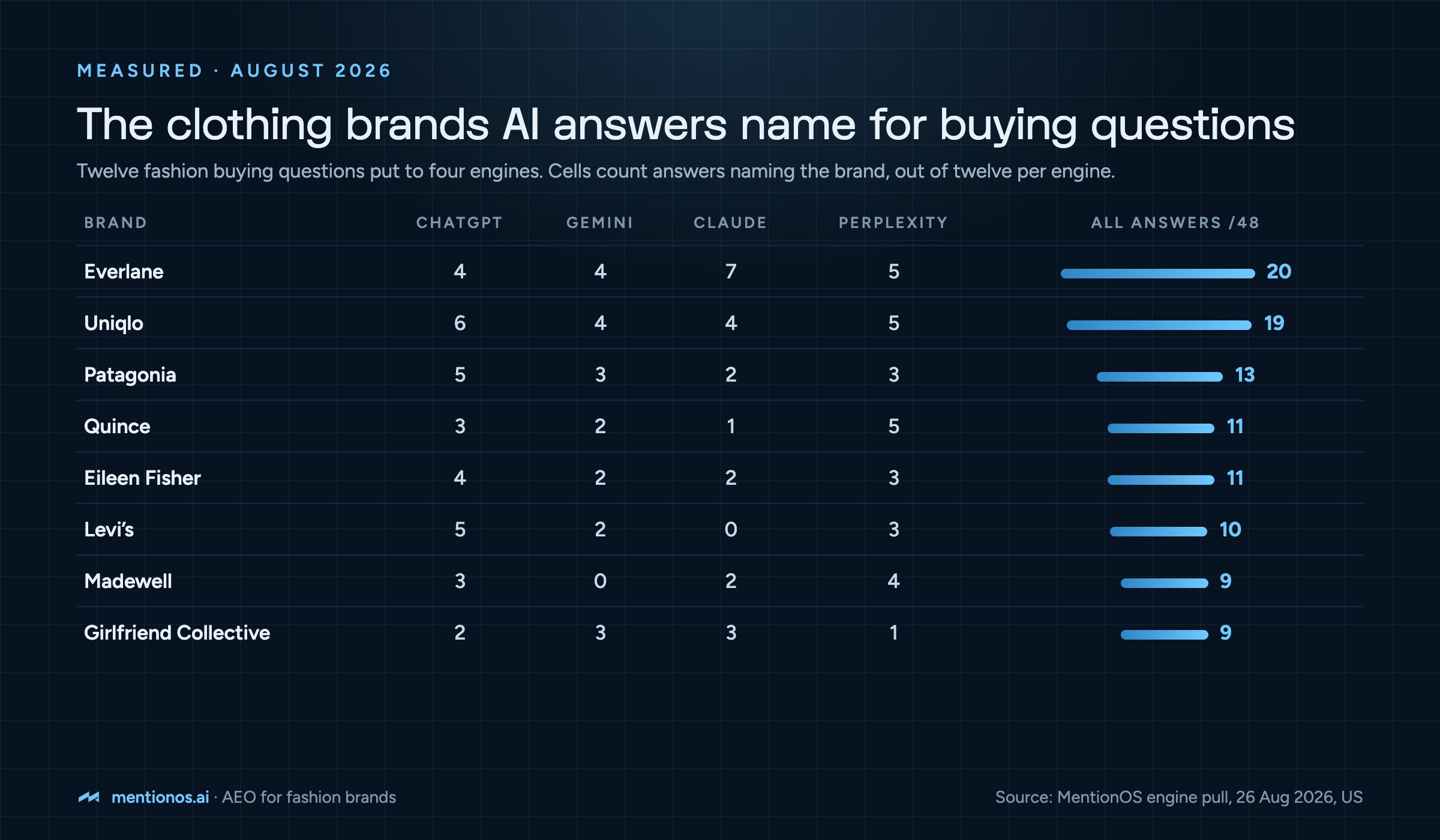
Look at what the leaders share. Everlane built its name on cost transparency, Patagonia on repairability and environmental record, Uniqlo on stated fabric technology, Quince on published pricing logic, Eileen Fisher on take-back programmes. These are the brands whose stories are made of checkable claims, and checkable claims are what an engine can safely repeat. Scale bought the giants no seat: advertising reach lives in a different universe from the corroborated-fact layer the answers draw on.
The twelve questions behind those numbers, exactly as we asked them: what are the best quality clothing brands that last; best sustainable clothing brands; is expensive clothing worth it or is fast fashion fine; best jeans brands for men; best workwear clothing brands for women; best athleisure brands; where should i buy basics like t shirts and hoodies; how can i tell if a clothing brand is good quality before buying; how do i know if an online clothing store is legit; build me a capsule wardrobe, which brands should i buy; best affordable clothing brands that are not fast fashion; and what clothing brands do stylists recommend.
A few results deserve their own line:
- Everlane and Uniqlo appeared in all four engines' capsule wardrobes. The default wardrobe already has defaults.
- Patagonia and Girlfriend Collective were named by every engine on the sustainability question.
- The engines split hardest in the middle: Levi's got five mentions from ChatGPT and zero from Claude; Sézane got four from Gemini and zero from Claude and Perplexity.
- On "affordable but not fast fashion", the engines reached for resale: Depop, Vinted and Poshmark appear inside the answers. Secondhand platforms are becoming the answer to fashion's ethics-versus-price problem, and they compete with brands for the naming.
The quality conversation has nobody in it
Asked how to tell whether a clothing brand is good quality before buying, all four engines gave the same answer: a sewing lesson. Check the seams and stitching, read the fibre content, feel the fabric weight, inspect zippers and lining, look at the care label. Not one engine named a brand. The value-doubt question ("is expensive clothing worth it or is fast fashion fine") ran nearly as empty, with three of four engines naming nobody.
Sit those two facts next to each other. The most-asked quality questions in fashion, the ones Google's own question boxes circle obsessively, produce answers with no brands in them. A brand that teaches garment quality honestly (what a well-made seam looks like, what fabric weight means, what its own products are made of and why) is writing the source material for a conversation currently held by nobody. In beauty, the equivalent empty space was the ingredient conversation. In fashion it's craft literacy, and it is wide open.
The scam-check question behaves the same way: zero brand recommendations, one consumer-protection checklist repeated four ways (HTTPS, domain age, reverse-image-searched product photos, payment protection, findable contact details, a returns policy that reads like a human wrote it). Fashion is counterfeiting's favourite industry, and a brand that makes its own authenticity easy to verify, official-store lists included, is answering a fear the engines take seriously.
Google tells the same story with different names
The Google half of our pull (all twelve questions, US, August 2026) confirmed the community pattern and added two twists of its own.
- An AI Overview sat on every one of the twelve questions.
- Reddit placed top-five on all twelve, the first clean sweep we've measured in any industry, and ranked first on most.
- Personal voices rank where institutions don't: three different Substacks and a string of individual style blogs hold top-five slots.
- goodonyou.eco, a sustainability rating directory, ranks on the ethics questions and gets cited inside engine answers. Fashion has grown its own registry layer, and the engines have found it.
- The security question belongs to antivirus companies (F-Secure, McAfee), which tells you how little fashion-native trust content exists.
- One oddity with a lesson in it: a rule of thumb called the 3-3-3 rule appears in Google's People-Also-Ask boxes under seven of our twelve queries, yet not one of the 48 engine answers mentions it. Google's question layer and the engines' answer layer have diverged, and a brand watching only one of them is reading half the conversation.
Where the answers get their taste
The citation trail behind the engine answers runs through four layers. Reddit first: Perplexity cited it in eleven of twelve answers, and it topped Gemini's resolved citations too. Fashion press second, with Vogue, GQ, Harper's Bazaar and WhoWhatWear carrying the authority the engines borrow for stylist-type judgements. Fashion's own rating and guide sites third: goodonyou.eco and The Good Trade both reach the answer layer directly. And video: YouTube sits high in Gemini's citation trail here as it did in beauty and software.
One number changes the strategy more than the rest. ChatGPT grounded only six of its twelve fashion answers in live sources; the other half came from model memory alone, the lowest grounding rate we've measured in any industry. Half of fashion's answer layer was decided months ago, by whatever the durable record said when the model was trained. The threads, reviews and writeups that exist about your brand today are next year's model memory, which makes the durable record a longer-term asset here than anywhere else we've looked.
What a fashion brand does with all of this
The through-line is almost uncomfortable in its simplicity: the engines name brands whose claims can be checked, and fashion is an industry that mostly trades in claims that can't. The work, in the order the data suggests:
- Publish the checkable version of your story. Fabric composition, construction detail, factory and origin information, pricing logic if you dare. The league leaders all did this years ago; it's why they're the leaders.
- Teach quality. The craft-literacy conversation is running with zero brands in it. Honest guides to seams, fabric weight and garment construction, written from your own production floor, become citable the day they're published.
- Feed the community and personal-voice layer. Reddit swept all twelve Google queries, and Substack writers rank beside Vogue. Products seeded with honest writers and communities that discuss them unprompted build the record engines read.
- Get into the registries. goodonyou.eco reaches both the rankings and the answers. Fashion's rating layer is small enough that presence in it is still cheap.
- Make authenticity verifiable. An official-retailer list and clear anti-counterfeit guidance answer the legit-store fear on your own domain.
- Mind the memory layer. With half of ChatGPT's answers running on model memory, the record you build this year decides the answers of next year. Durable, dated, factual pages outlast campaign cycles.
The technical rules from the rest of this series apply unchanged (server-rendered pages, product and organisation structured data, an llms.txt, one brand name spelled one way everywhere); the AEO audit guide walks the whole checklist.
Fashion's clock
Fashion answers move on drops, seasons and discourse cycles, and the discourse can turn a brand's answer-layer standing faster than any product change. A viral thread about quality decline, a documentary about a factory, a sustainability rating downgrade: each rewrites the record engines draw on. The workable rhythm is a full question-set audit each season, monthly reads of the quality, ethics and category questions, and a same-week content response when your materials, pricing or ratings change.
Watching that drift and responding to it is a standing job, and it's the job MentionOS does as the operating Agent for AEO. It reads how the engines describe your brand across these questions, writes and ships the approved fixes to your own site, and shows you the movement, so a fashion brand gets the loop without hiring for it.
Frequently asked questions
Why do AI engines recommend Everlane more than Nike?
Presence in answers tracks corroborated, checkable claims, and Everlane's transparency-first record gives engines more safely repeatable material than a giant's advertising does. In our August 2026 pull, Everlane led with 20 of 48 answers while Nike appeared in 6. Scale and answer-layer trust are different games; the brands that publish verifiable facts win the second one.
Do secondhand platforms compete with fashion brands in AI answers?
In our data, yes. Depop, Vinted and Poshmark appear inside engine answers to the affordable-but-ethical questions, meaning resale is being offered as an alternative to buying new at all. A brand competing on price and ethics is now competing with the secondhand market inside the same answer.
What should a small fashion label do first for AEO?
Publish the checkable facts (materials, construction, origin) in crawlable text, then put honest effort into the community and review record, because Reddit held a top-five slot on every fashion query we measured and the engines cite it heavily. The craft-literacy space is the cheapest authority available: teaching quality honestly earns citations no ad budget reaches.
How often do AI answers about fashion brands change?
Seasonally at the surface and slowly underneath. Live-retrieval answers shift with new threads, ratings and press, but half of ChatGPT's fashion answers in our pull came from model memory, which updates on training cycles measured in months. That split rewards brands that maintain a durable, factual record over those that sprint campaigns.