The engines have already furnished the house
Home is the biggest answer market we've measured, by demand and by decisiveness. "Best mattress" draws around 74,000 US searches a month in our August 2026 pull, "non toxic cookware" 49,500, "best bed sheets" 33,100. And when we handed the whole problem to the engines ("furnish my first apartment, which brands should I buy from"), ChatGPT returned fourteen brands in one answer, room by room: IKEA and Wayfair for the bones, a mattress name, a sheets name, a cookware name, and Facebook Marketplace for the rest.
That last item repeats a pattern we first saw in fashion: the secondhand market now competes inside the answer. But home's defining feature is different, and it took the full pull to see it. We put twelve home and living buying questions to ChatGPT, Gemini, Claude and Perplexity (48 answers) and the same twelve through Google, and what came back wasn't one market with one leader. It was a dozen small markets, each already settled.
One roof, a dozen shortlists
The overall league makes IKEA look dominant, and at the generalist layer it is: 18 of 48 answers, ahead of Wayfair at 12. But the totals flatten the real structure.
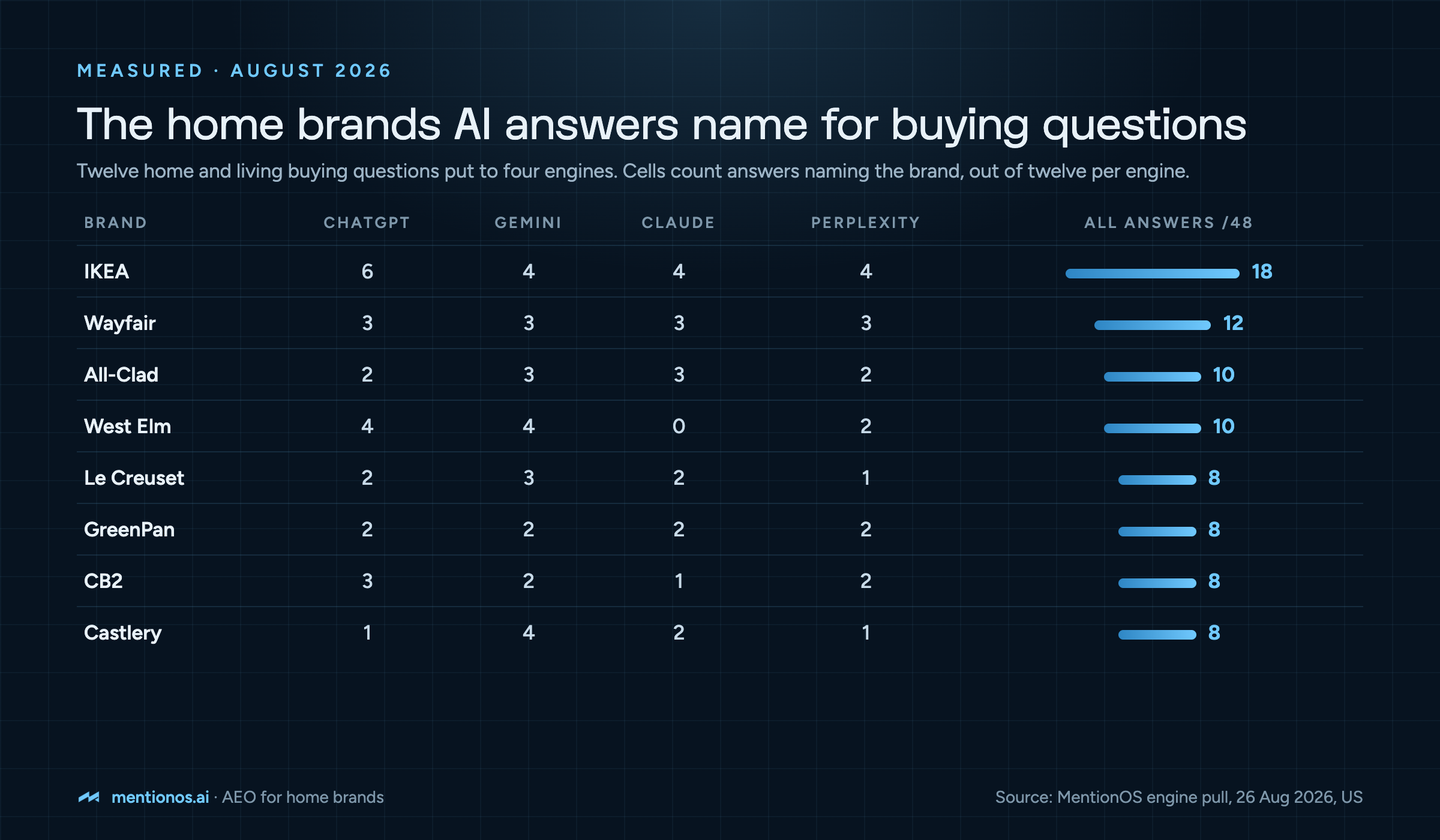
Ask by category and each question summons its own committee:
- Side-sleeper mattresses: Helix named by all four engines, Saatva by three, WinkBed by three. The generalist giants never appear.
- Cookware: All-Clad, Le Creuset, GreenPan and Tramontina anchor every engine's list, with Caraway and Our Place carrying the non-toxic variant.
- Sheets: Brooklinen, Boll & Branch, Quince and Cozy Earth form the four-engine core.
- Small-space furniture: IKEA leads, but Burrow, Castlery and CB2 take named slots beside it.
The strategic reading: a home brand is never competing in "home". It competes in one micro-category with a shortlist three to five names long, already agreed across engines. Brooklinen doesn't fight IKEA; it holds "sheets". The DTC generation that picked one product and went deep now owns those answer slots, while the generalists own breadth. Both strategies won; the brands in between, known for nothing specific, are the ones the answers skip.
The twelve questions, exactly as asked: best mattress for side sleepers; best cookware brands; are mattresses in a box as good as traditional mattresses; best bed sheets brands; best non toxic cookware; best furniture brands for small apartments; is expensive cookware worth it; how can i tell if furniture is good quality before buying; how do i know if an online furniture store is legit; furnish my first apartment, which brands should i buy from; best affordable furniture brands; and what home brands do interior designers recommend.
A carpentry lesson where brands could stand
Asked how to judge furniture quality before buying, all four engines taught woodworking: dovetail joints, solid wood against veneer and particle board, drawer construction, frame weight, upholstery density. Zero brands. The is-it-worth-it questions ran nearly as bare: on expensive cookware, ChatGPT and Perplexity named nobody, and on mattress-in-a-box doubt, half the engines answered with materials science alone.
Every industry we've measured has one of these empty rooms, and home's is craft literacy about construction. The brand that teaches joinery honestly, from its own workshop, with its own products as worked examples, gets to stand in a conversation that currently has no commercial presence at all. The legit-store question rounds out the picture the usual way: consumer-protection checks, with the engines citing recognisable retailers as the safe examples, which quietly rewards being recognisable.
The review economy writes these answers
Home's citation trail is the most institutional of any consumer category we've pulled. Consumer Reports appeared in nine answers' citations, Homes & Gardens in nine, Architectural Digest in seven, Apartment Therapy in seven, with the specialist testers (Sleep Foundation, NapLab, Mattress Nerd) behind them and Serious Eats and Food Network carrying cookware. Reddit still leads for Perplexity (eleven of twelve answers), and YouTube tops Gemini's resolved citations here for the fifth industry in a row, sixteen of its hundred resolved links.
The map for a home brand has three landmarks. Professional testing programmes matter more here than anywhere: a Consumer Reports or Wirecutter-class result is answer-layer currency. The shelter press and its category specialists hold the middle. And the video-plus-forum layer carries the validation traffic. Claude grounded eleven of its twelve home answers, its highest rate in our series, so this is also the category where the live, current record counts most.
Claiming a shortlist
The work, in the order the data suggests:
- Pick the category you intend to own and say so everywhere. The engines reward brands that stand for one thing; "known for sheets" beats "sells everything" in every answer we read.
- Get tested. Submit to the professional review programmes and the specialist testers in your category; their verdicts are the citations engines lean on.
- Teach construction. The quality conversation is empty. Materials, joinery, what a warranty means, written from the workshop floor with your own products as evidence.
- Feed the forum and video record. Reddit swept the validation questions and YouTube leads Gemini's sources; honest presence in both compounds.
- Respect the secondhand rival. Marketplace and resale now appear inside first-apartment and affordability answers. Durability claims and buy-once framing are how new brands compete with used ones.
The technical baseline is unchanged from the rest of this series (server-rendered pages, product and organisation schema, an llms.txt, one name spelled one way everywhere); the AEO audit guide carries the full checklist.
Home's clock
Home answers turn on review cycles and product-line refreshes. A mattress re-test, a cookware coating reformulation, a new tester entering your category: each can re-order a shortlist that took years to settle. The rhythm that fits: a full audit of your category's question set twice a year, monthly reads of your shortlist questions, and an immediate content pass whenever your materials, lines or review results change.
Keeping watch on a dozen settled shortlists is exactly the kind of standing job MentionOS exists for. As the operating Agent for AEO it reads how the engines rank your category, writes and ships the approved responses to your own site, and reports what moved, so a home brand holds its shortlist without staffing a war room.
Frequently asked questions
Which home brands do AI engines recommend most?
At the generalist layer, IKEA (18 of our 48 August 2026 answers) and Wayfair (12). But recommendations run category by category: Helix and Saatva led mattresses, All-Clad and Le Creuset cookware, Brooklinen and Boll & Branch sheets. The useful question for a brand is who owns its specific shortlist, and our data shows those shortlists are settled but small.
Can a new home brand get into AI answers?
Yes, by the niche door. The measured shortlists are three to five names deep per micro-category, built from professional reviews, forum consensus and video coverage, all earnable surfaces. The empty craft-literacy conversation and the specialist testers are the two cheapest entry points our pull shows.
Do professional reviews matter more than customer reviews for AEO in home?
In our data, both feed the answers through different doors. Consumer Reports and the specialist testers dominate the citation trail (professional verdicts are what engines quote), while Reddit and customer-review volume carry the validation questions. A brand strong in only one layer shows up lopsided.
How often do AI answers about home products change?
On review cycles more than seasons. Shortlists held steady across our engines, which suggests slow drift, but a major re-test or a materials controversy can rewrite a category quickly. Twice-yearly full audits with monthly shortlist reads fit the pace we observed.