Why did travel move into AI conversations first?
Planning a trip was always a conversation pretending to be a search. A traveller holds five constraints at once: dates, budget, who's coming, pace, and how much risk feels acceptable. No results page answers all five together. That's why planning a trip used to mean twenty open tabs.
A chat assistant holds all of it in one thread and answers with a plan. Travellers worked this out early. In our August 2026 pull, US searches for "ai trip planner" run around 1,900 a month, and that only counts the people who name the behaviour. Most ask ChatGPT directly and never show up in keyword data at all.
For an operator, the problem starts earlier than the website. When the assistant builds the shortlist and your brand isn't on it, the booking is gone before anyone visits anything, and no analytics tool records the loss. Travel is where the pattern documented in the complete AEO guide arrived first and cuts deepest. This guide is the measured version: what travellers ask, who gets named today, and how a brand earns its way in.
What do travel buyers ask the engines?
Most travel buying conversations fall into five question shapes. The phrasing below comes straight from live People-Also-Ask boxes in our August 2026 pull.
- Category-open: "what are the top rated group travel companies", "who is the best luxury travel company"
- Validation: "is it cheaper to book trips through a travel agent", plus the scam check every unfamiliar operator faces
- Honest doubt: "what are the disadvantages of group tours", "is it better to go on a tour or on your own"
- Destination-specific: "best travel agency for greece trips"
- Planning: the ten-days-in-Greece prompt, where operators get named as a side effect of building the itinerary
The doubt questions deserve the most attention. A trip is prepaid, taken far from home and hard to refund, so travellers interrogate the category before they trust anyone inside it. Keep those questions in mind, because when we put them to the engines directly, almost no brands came back.
Who holds the trust slots on Google? We measured.
We ran the Google half of the audit method on three core travel buying questions in US Google, August 2026. What came back:
- AI Overviews appeared on all three questions.
- Reddit ranked top-five on all three, and first on two.
- The remaining advice slots went to Facebook groups, independent trip bloggers and community forums.
- The big online travel agencies were absent. So was every operator brand, except where a third party was talking about them.
The pattern is hard to miss. The surfaces deciding whether you get named are peer conversations and first-hand writeups, which happens to be exactly the material AI engines lean on. And nobody owns those slots yet. Communities hold them, and a brand willing to show up properly can still get in.
Which operators do the engines name? We asked all four.
Then we asked the engines themselves. In August 2026 we put twelve travel buying questions to ChatGPT, Gemini, Claude and Perplexity and counted every brand across the 48 answers. The twelve, word for word:
- what are the top rated group travel companies
- who is the best luxury travel company
- best group tour companies for solo travelers
- is it cheaper to book trips through a travel agent
- are group tours worth it
- what are the disadvantages of group tours
- is it better to go on a tour or travel on your own
- best travel agency for greece trips
- best tour operators for italy
- i have 10 days in greece, which tour companies should i consider
- how can i tell if a travel company is legitimate
- best adventure travel companies
Four things stood out.
Two operators dominate. Intrepid Travel came up in 21 of the 48 answers, G Adventures in 19. Nobody else was close: Contiki 13, Exodus 11, Trafalgar 10, then a couple of dozen operators named once or twice.
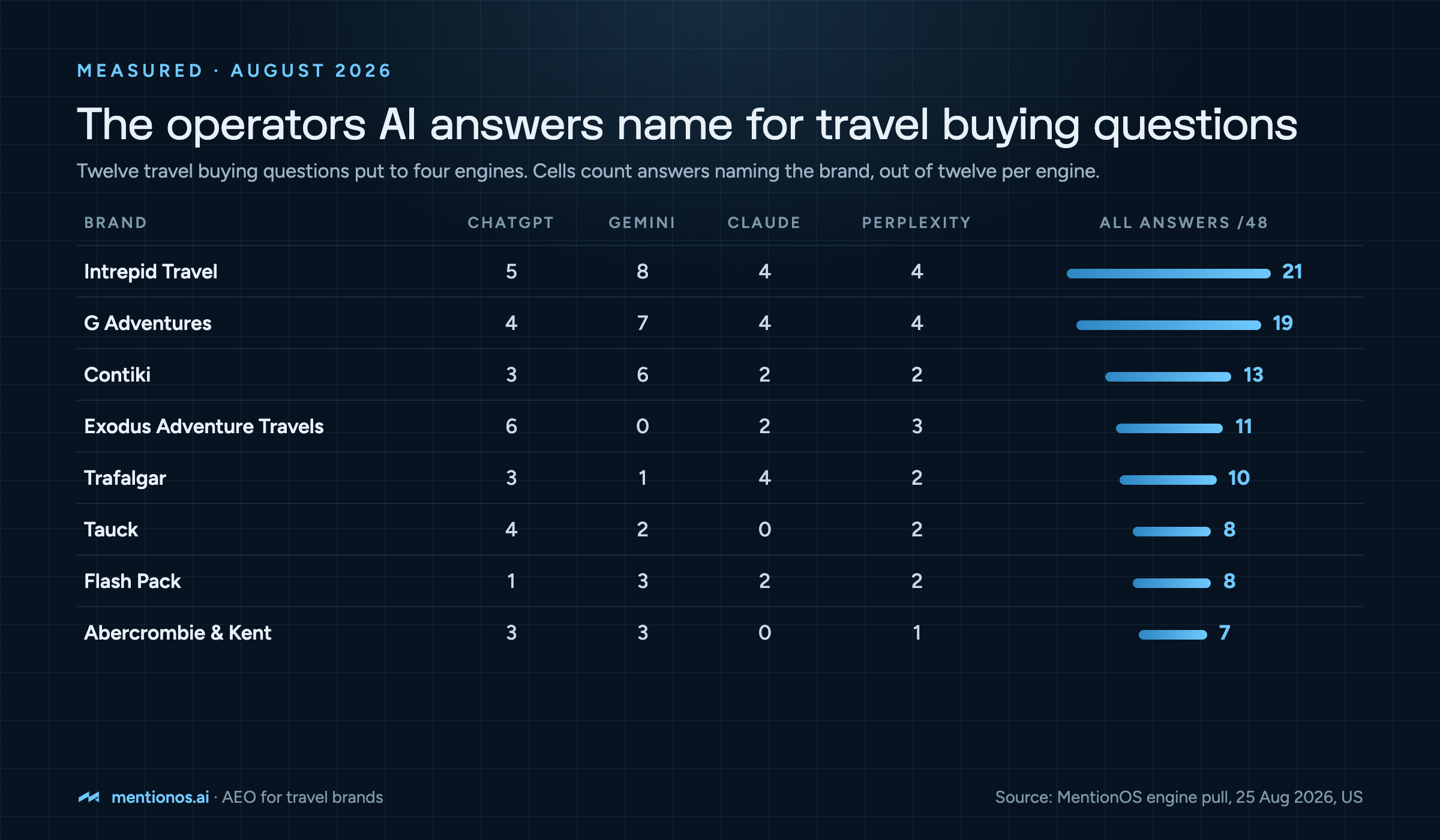
Below the leaders, the engines stop agreeing. Exodus led ChatGPT's answers with six mentions and never appeared in Gemini's. The luxury question got four different shortlists from the four engines. If you're reading your visibility off one engine, you're reading a quarter of the market.
The doubt questions came back with almost no brands in them. On "worth it", "disadvantages" and "agent or independent", three of the four engines named nobody. These are the conversations where travellers decide what kind of trip to buy, and right now they run without brands in them. Nobody has claimed that ground.
The scam question named nobody either, and its answer is a checklist. Asked how to tell whether a travel company is legitimate, all four engines reached for the same apparatus: ASTA and IATA membership in every answer, Better Business Bureau standing in three of them, the UK's ATOL and ABTA schemes in Gemini's. Accreditation is trust an engine can check.
Two more numbers worth knowing. Perplexity backed all twelve of its answers with sources and cited Reddit in eleven; Gemini's citation trail also led to Reddit first. And Expedia and Booking.com appeared in none of the 48 answers. The engines treat booking infrastructure and buying advice as separate jobs, and shortlists come out of the advice job.
What does all of this mean for a travel brand?
Strip the numbers away and the map is short. The engines name the operators that show up in community threads, in writeups by independent writers, and in the registries that vouch for legitimacy. You can't buy placement in any of those. You can earn it in all of them. And the doubt conversations, the highest-trust moments in the whole buying journey, are still sitting empty. The rest of this guide is that work, in order.
How does a travel brand enter the trust stack?
Communities, on community terms
Reddit and the forums run travel's advice layer, and they're allergic to marketing. The operators that win there are the ones travellers describe unprompted, plus the rare brand account that answers questions with genuine specifics and no pitch. The work itself is unglamorous: watch the threads where your destinations and category come up, contribute answers a moderator would defend, and treat every organic mention as something to earn more of. The engines read those threads as evidence.
Reviews and the post-trip loop
Travel reviews concentrate on a handful of platforms travellers already trust, and the engines cite them on validation questions. The move that compounds is operational: a review request after every departure, as standard practice, so the evidence grows with every trip you run. Recency counts as much as volume. Thirty recent, detailed reviews corroborate you better than two hundred stale ones.
Accreditation the engines can check
This one comes straight from the scam-question finding. Hold the memberships the engines check by name (ASTA, IATA, and ATOL or ABTA where you operate) and state them on your own pages, consistently. When a nervous traveller asks whether you're legitimate, that's the checklist the engine runs. If the answer is already sitting on your site, the question costs you nothing.
The writers the answers already quote
Independent bloggers and community authorities hold advice slots that brands can't buy. These writers take press trips, review operators and answer reader questions, and one honest, detailed writeup from a trusted voice keeps getting cited for years. It's PR aimed at the citation layer rather than the press-release layer, and in travel it outworks the glossy kind.
What should a travel brand publish?
Travel brands own the thing content standards reward most: first-hand experience. Real itineraries run on real dates, real costs, real photographs, the things that went wrong and how they got handled. Published at that level of detail, a page becomes something an engine can lift and a traveller can verify. The priorities, straight from the question data:
- A "worth it" page for each flagship offering that engages the doubts head-on, including the disadvantages travellers demonstrably probe
- Destination-and-situation pages matching how buyers scope a trip: group size, style, season
- An honest independent-versus-organised comparison for your category, because the travellers reading it are deciding what kind of trip to buy, and the brands present in that deliberation get named once the shape is chosen
- Visible dates and a seasonal refresh pass, because prices and availability go stale fast, and stale specifics on a travel page do more damage than none
The technical layer travel gets wrong
Travel sites carry one risk most industries don't: booking engines and itinerary widgets built as JavaScript applications. AI crawlers execute no scripts, so that content is invisible to them. The safe default is to server-render everything that answers a question and keep the interactive booking layer as an enhancement on top. Then the entity work: structured data for the organisation and offerings, FAQ markup on question pages, an llms.txt stating your operator facts, and the same brand facts everywhere an engine might look, from your site to your review profiles to your community presence.
Running the loop on travel's calendar
Travel answers drift on a seasonal clock. January's questions are summer-planning questions; September's aren't. The answer pool re-forms before each booking season as new reviews and writeups land. The cadence that works: a full audit of your question set before each booking season opens, monthly reads of the validation and competitive questions the rest of the year, and refreshed specifics live before the planning wave hits, on the retrieval-first timing how AEO works explains.
That loop is continuous work with a seasonal pulse, and it's the loop MentionOS runs as the operating Agent for AEO: it reads the engines, ships approved content and fixes to your own site, and reports the movement, for travel brands that don't have a team to hand it to.
Frequently asked questions
How do travel brands get recommended by ChatGPT?
By being present and corroborated where its material comes from: community threads discussing your category, recent detailed reviews, independent writeups, and your own pages answering buyer questions with first-hand specifics. Consistent brand facts across all of it make the naming easy for the engine. The general method is in how to get ChatGPT to recommend your brand.
Do OTAs and price platforms matter for AI answers in travel?
Less than you'd expect. The large booking platforms were absent from the advice results in our Google measurement, and Expedia and Booking.com were named in none of the 48 engine answers in our August 2026 pull. Distribution muscle and answer-layer trust turn out to be separate games in travel, which is precisely the opening for operators without OTA-scale budgets.
Can a small operator beat big brands in AI answers?
Travel is the vertical where the answer is most honestly yes. The trust stack runs on peer conversation, first-hand evidence and checkable accreditation. A small operator can earn all of those, a large one can't fake them, and our measurements show the advice slots sitting with communities, with the incumbent brands locked out. Specific, honest and well-corroborated beats big and generic in a composed answer.
How often do AI travel answers change?
On a seasonal pulse over a constant drift. New reviews, writeups and model updates move answers year-round, and movement accelerates ahead of booking seasons as fresh content enters the pool. Monthly reading of the validation and competitive questions, stepped up before your season, is the practical cadence.