Download App
Shopify SEO vs AI Optimization: Key Differences
E-Commerce SEO
Feb 11, 2026
Compare Shopify SEO and AI optimization: learn differences in keywords, schema, llms.txt, and measurement — and how to combine both for product visibility.
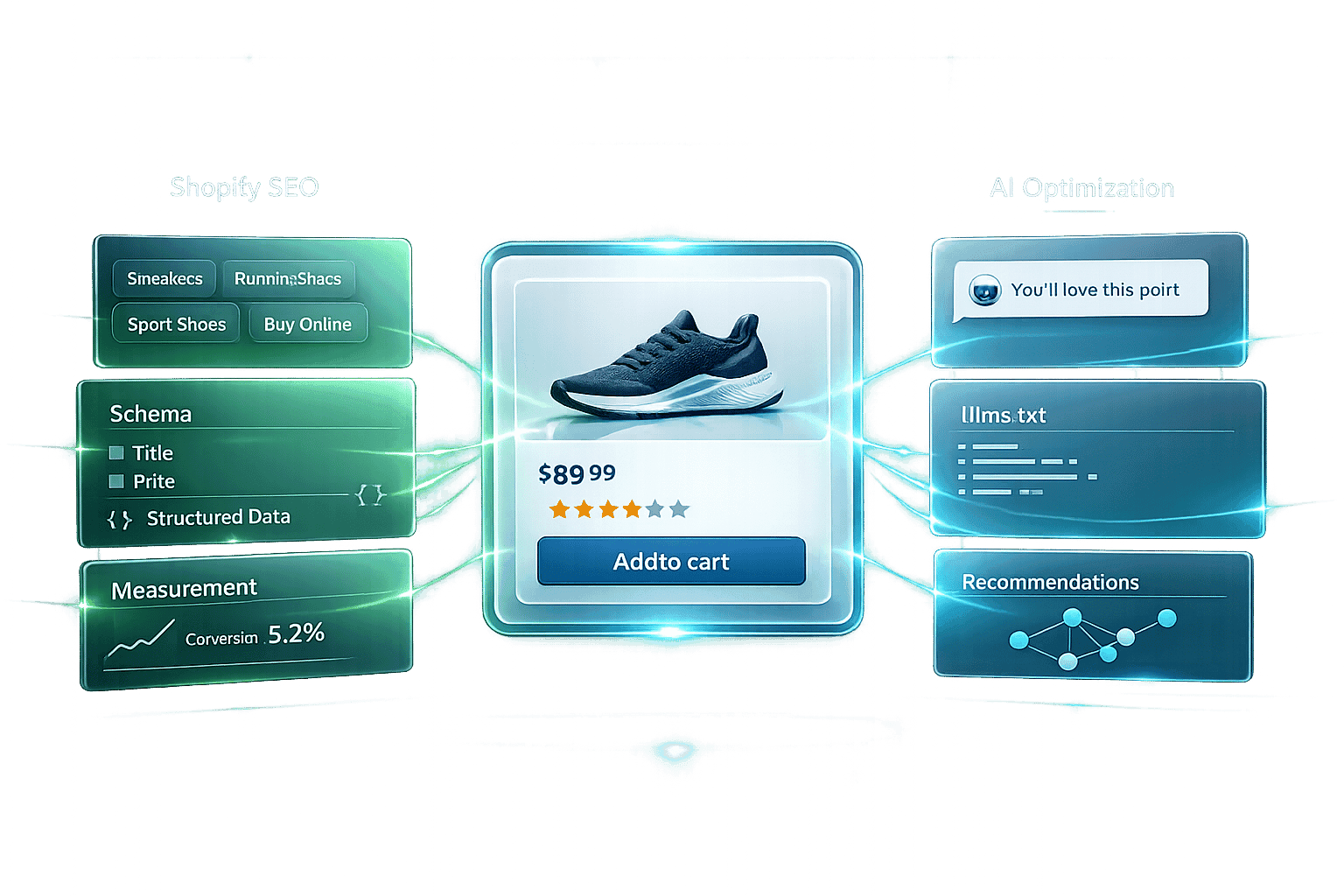
AI is changing how people shop. Instead of scrolling through search engine results, customers now rely on AI assistants like ChatGPT or Gemini to recommend products instantly. This shift means Shopify merchants need to rethink their strategies.
Here’s the bottom line:
Shopify SEO focuses on keywords, meta tags, and rankings to drive traffic from Google or Bing.
AI Optimization ensures your store’s data is structured so AI can recommend your products in conversations.
In 2024, generative AI searches drove 1,300% more traffic to U.S. retail sites compared to 2023. AI mentions are becoming as important as Google rankings. If your content isn’t AI-ready, you risk being invisible to these high-intent shoppers.
Quick Comparison
Feature | Shopify SEO | AI Optimization |
|---|---|---|
Focus | Keywords, meta tags, backlinks | Structured data, schema markup |
Output | SERP rankings | AI citations, recommendations |
Metrics | Click-through rates, impressions | Citation share, sentiment |
Update Frequency | Monthly/quarterly | Real-time |
To stay competitive, Shopify merchants must combine both approaches. SEO builds traffic, while AI Optimization ensures your products are visible to AI-driven shoppers.
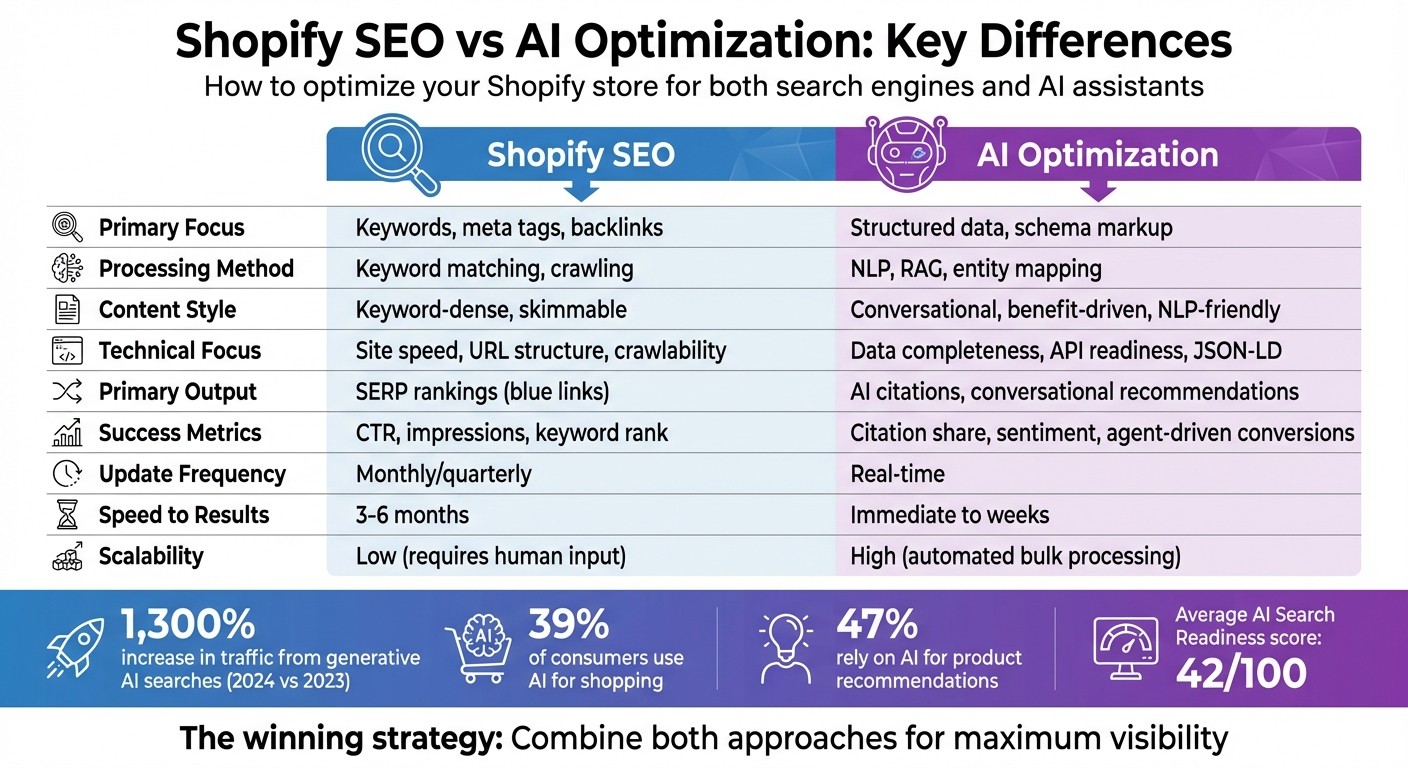
Shopify SEO vs AI Optimization: Complete Comparison Chart
Shopify SEO Optimisation Guide for Beginners in 2026 (AI Optimization Step-By-Step SEOWILL)

How Each System Works
Traditional Shopify SEO and AI Optimization rely on different technical frameworks, each requiring Shopify merchants to adapt their strategies accordingly.
Shopify SEO builds on the principles of traditional SEO but places added emphasis on factors like keyword placement and technical metrics. Search engine bots crawl your store, evaluating elements such as meta titles, product descriptions, and URLs, alongside performance benchmarks like site speed. For example, Shopify SEO aims to meet targets like a Largest Contentful Paint (LCP) of ≤2.5 seconds and an Interaction to Next Paint (INP) of <200ms, benchmarks set for 2026 [5]. The ultimate goal? To secure a spot in the coveted top ten blue links on a search engine results page (SERP).
AI Optimization, on the other hand, takes a completely different approach. Instead of focusing solely on keywords, it uses large language models (LLMs) and natural language processing (NLP) to understand user intent and semantic relationships. For instance, if a shopper asks an AI assistant, “Can you suggest brands similar to Hoka for flat feet?” the system interprets the query and generates relevant recommendations by analyzing product feeds, customer reviews, and schema markup [6]. As Jason Jackson, Lead Technical SEO Strategist at Codal, puts it:
"The only remaining competitive differentiator is how well your product information is structured for machine consumption" [2].
The way these systems process data highlights their differences. Traditional SEO relies on keyword matching and established ranking algorithms, while AI Optimization uses Retrieval-Augmented Generation (RAG) to extract data from structured formats like JSON-LD schema, llms.txt files, and detailed product attributes, such as "arch_support: flat_feet" [2] [4]. Furthermore, their success metrics differ: traditional SEO measures progress through SERP rankings, click-through rates (CTR), and impressions, whereas AI Optimization evaluates performance based on citation share - how often your brand is mentioned in AI-generated answers.
Below is a side-by-side look at the key differences:
Feature | Traditional Shopify SEO | AI Optimization (AEO/GEO) |
|---|---|---|
Primary Input | Keywords, Meta Tags, Backlinks | Structured Data (Schema), llms.txt, Q&A |
Processing Method | Keyword Matching, Crawling | NLP, RAG, Entity Mapping |
Content Style | Keyword-dense, Skimmable | Conversational, Benefit-driven, NLP-friendly |
Technical Focus | Site Speed, URL Structure, Crawlability | Data Completeness, API Readiness, JSON-LD |
Primary Output | SERP Rankings (Blue Links) | AI Citations, Conversational Recommendations |
Success Metric | CTR, Impressions, Keyword Rank | Citation Share, Agent-driven Conversions |
At its core, the shift is about moving from targeting keywords to focusing on semantic entities. These entities define the relationships between your brand, its products, and customer needs - elements that AI models rely on to create meaningful, personalized recommendations. As AI assistants increasingly act as digital storefronts, understanding these distinctions becomes essential for Shopify merchants looking to stay competitive.
Content Creation and Measurement
The way you create and evaluate content varies greatly between traditional Shopify SEO and AI Optimization. Traditional SEO revolves around crafting product descriptions and blog posts aimed at ranking high on search engine results pages (SERPs). Here, the focus is on engaging human readers with persuasive marketing copy that turns clicks into sales. Success is typically measured through metrics like keyword rankings, organic traffic, click-through rates (CTR), and bounce rates. This approach naturally shapes how performance is assessed.
AI Optimization, on the other hand, calls for an entirely different strategy. Instead of chasing specific keywords, the goal is to create content that AI can easily reference. This means writing structured, conversational paragraphs that answer natural language questions like, "What’s the best yoga mat for beginners under $50?" Product descriptions need to include clear, queryable details - such as materials, dimensions, and compatibility - formatted in a way that AI systems can easily extract and use. This structured content ensures AI models can accurately integrate your product information into their recommendations.
The way success is measured also shifts with AI Optimization. While traditional SEO focuses on SERP visibility, AI Optimization tracks how often AI assistants - like ChatGPT, Gemini, or Perplexity - recommend your brand in their responses. Sentiment analysis becomes a key metric to ensure that AI tools present your brand positively and reliably. For example, in late 2025, a mid-7-figure personal care brand revamped its content to align with conversational queries. The result? A 34% boost in organic search traffic within three months, along with increased appearances in Google’s AI-powered recommendations [8].
Another major difference lies in how frequently content needs updating. Traditional SEO content can be refreshed monthly or quarterly to maintain rankings. In contrast, AI Optimization demands real-time or near real-time updates, particularly for pricing, inventory, and product details. AI models prioritize up-to-date, consistent data to maintain their reliability. A great example is Skinny Mixes, which automated data synchronization between its Shopify store and back-office systems in 2025. This move led to a 75% year-over-year increase in order volume and generated over $3 million in additional annual revenue [4]. These contrasting strategies underscore why Shopify brands must adapt to AI-driven recommendations to stay competitive.
Aspect | Traditional Shopify SEO | AI Optimization |
|---|---|---|
Content Style | Keyword-focused, persuasive marketing copy | Conversational, structured, entity-based |
Primary Format | Blog posts, optimized product descriptions | FAQ schema, detailed specs, natural language paragraphs |
Update Frequency | Periodic (monthly/quarterly) | Real-time (especially pricing/inventory) |
Success Metrics | Keyword rankings, organic traffic, CTR | AI mentions, citation share, sentiment analysis |
Measurement Focus | SERP position and click volume | Visibility in AI recommendations and trust signals |
How to Implement Both Approaches
As AI assistants reshape the way customers interact with online stores, combining traditional Shopify SEO with AI Optimization is becoming more important. The challenge is knowing where to focus your efforts and which tools will deliver the biggest impact.
Start with the technical basics. Before your store can rank on search engines or be recognized by AI assistants, you need to address foundational issues. Shopify stores often struggle with duplicate product URLs - this happens when a product appears in multiple collections, creating separate URLs for each instance. To fix this, adjust your theme files (e.g., main-collection-product-grid.liquid) so product links use {{ product.url }} instead of collection-specific URLs [7]. Also, prioritize site speed improvements; even a 0.1-second reduction in load time can boost conversion rates by over 10% [7]. Use tools like PageSpeed Insights and Cloudflare to fine-tune your store’s performance.
Add AI-specific features for optimization. Include an llms.txt file in your Shopify root directory. Think of this as an XML sitemap tailored for AI crawlers - it provides a snapshot of your brand and organizes your product categories [9][4]. On top of basic Product schema, integrate additional schema types like FAQPage, Review, and OfferCatalog. These give AI models the context they need to interpret your store’s data more effectively [7][10].
Once the groundwork is laid, shift your focus to enhancing your data and content for both SEO and AI.
Track performance for both approaches. Traditional SEO relies on tools like Google Search Console to monitor keyword rankings and organic clicks. AI Optimization, on the other hand, requires tracking how often your brand is mentioned by AI platforms like ChatGPT, Perplexity, and Gemini. Tools like MentionOS make this easier by identifying key queries where competitors are gaining visibility and offering insights to close those gaps. For $29/month, you can track up to five prompts and turn conversational AI into a measurable revenue source.
Implementation Step | Shopify SEO Action | AI Optimization Action | Tools | Expected Timeline |
|---|---|---|---|---|
Technical Setup | Fix duplicate URLs, improve site speed, submit XML sitemaps | Add | PageSpeed Insights, Cloudflare | 1–2 Weeks |
Data Structure | Add Product and Organization schema | Implement FAQ, Review, and OfferCatalog schema | Schema.org, Google Rich Results Test | 2–3 Weeks |
Content Creation | Write keyword-focused product descriptions and blogs | Develop conversational FAQs and natural language content | Shopify Magic, Jasper, Surfer SEO | 1–4 Weeks |
Measurement | Monitor SERP rankings and organic clicks | Track AI mentions, citations, and sentiment | MentionOS, Google Search Console | Ongoing |
Consistent monitoring of both organic traffic and AI-driven metrics is key to staying competitive.
Traditional SEO takes time; AI Optimization delivers faster results. While SEO improvements typically take 3–6 months to show results, AI Optimization can yield benefits almost immediately. For example, during the 2024 holiday season, U.S. retail websites experienced a 1,300% spike in traffic from generative AI searches compared to the previous year [1]. Visitors from AI-driven searches also spent 8% more time on-site and viewed 12% more pages than those from traditional search referrals [1]. The opportunity to secure a foothold in AI recommendations is here now, but it won’t last forever.
Advantages and Disadvantages
Each approach brings its own set of strengths and challenges, shaping how Shopify merchants allocate resources and plan their growth strategies.
Traditional Shopify SEO is all about building long-term organic authority. It offers predictable costs, such as developer fees or SEO apps, and delivers steady, low-maintenance traffic once high-intent keywords are ranked. However, for stores with large catalogs, manual optimization can become extremely costly. Additionally, SEO tends to move at a slower pace - algorithm changes often take 3–6 months to show measurable results.
AI Optimization, on the other hand, is designed for immediate scalability and quick wins. Tools like Shopify Magic (included with all plans) and Alli AI (starting at $141/month) can generate thousands of optimized product descriptions in just minutes, making them a game-changer for merchants with extensive catalogs. Interestingly, visitors referred by AI spend 8% more time on-site compared to those arriving via traditional search [1]. AI Optimization can adapt in real time to the evolving landscape of conversational commerce. However, stores with unstructured product data risk being overlooked by AI assistants [3]. As Gentian Shero, Co-founder & CSO of Shero Commerce, points out:
"AI systems are not choosing a position on a results page. They are deciding whether your content is clear enough to use in an answer" [3].
The cost-effectiveness of each approach largely depends on the size of your product catalog and your growth stage. For smaller stores with fewer than 100 products, traditional SEO may provide a better return on investment due to its manageable workload. But for larger catalogs, the automation capabilities of AI Optimization are practically indispensable. With the average AI Search Readiness score for Shopify stores sitting at just 42 out of 100 [3], there’s substantial room for improvement to increase visibility in AI-driven recommendations.
Factor | Shopify SEO | AI Optimization |
|---|---|---|
Cost Driver | Manual labor, developer fees, SEO apps | AI tool subscriptions, API usage |
Scalability | Low (requires more human input as catalog grows) | High (automated bulk processing) |
Speed to Results | 3–6 months | Immediate to weeks |
Adaptability | Slow (reacts to algorithm updates) | Fast (real-time data synthesis) |
Long-term ROI | High (stable organic traffic) | High (brand authority and high-intent leads) |
Risk | Algorithm penalties, ranking volatility | AI hallucinations, content quality issues |
Failing to adopt AI Optimization could lead to missed opportunities. With 39% of consumers already using generative AI for shopping and 47% relying on it for product recommendations [1], businesses that don’t prepare for conversational commerce risk falling behind. Structured data and AI readiness are now essential for staying visible in an increasingly AI-driven market. As AI assistants become the new digital storefronts, merchants must embrace AI Optimization to attract high-intent leads. Platforms like MentionOS offer actionable insights to help businesses adapt to this shift.
Ultimately, combining both strategies is key. AI assistants are reshaping the way Shopify merchants approach their digital storefronts, and integrating traditional SEO with AI Optimization ensures a balanced, competitive edge in this evolving landscape.
Conclusion
Choosing between traditional Shopify SEO and AI Optimization isn't an either-or decision - it's about blending the two strategically. Traditional SEO lays the groundwork with essentials like fast load times, clean site architecture, and keyword-rich content that performs well in Google's search results. On top of that, AI Optimization takes this foundation and makes it accessible to conversational AI tools that are reshaping how people shop. With 39% of consumers already using AI for product discovery and 47% relying on it for recommendations, ignoring this shift could mean falling behind [4].
By building on solid SEO fundamentals, AI Optimization ensures your store is ready for the future. Jason Jackson, Lead Technical SEO Strategist at Codal, calls this the "Invest Once, Benefit Twice" method. Enhancing structured data - such as schema markup, JSON-LD Q&A pairs, and filterable product feeds - not only improves your SEO today but also prepares your catalog for AI assistants like ChatGPT, Gemini, and Perplexity [2].
The numbers are hard to ignore. During the 2024 holiday season, U.S. retail websites experienced a staggering 1,300% surge in traffic from generative AI searches [1]. Meanwhile, 33% of consumers expressed a willingness to complete purchases through AI agents [2]. This means the window for early adoption is closing fast. Stores that implement tools like llms.txt files, optimize product pages for conversational queries, and maintain clean, synchronized data across platforms will have a significant advantage. Those sticking with traditional SEO alone risk losing visibility at the very start of the buyer's journey.
The winning formula combines the strengths of both approaches. Use traditional SEO to capture high-intent keyword traffic and build domain authority. At the same time, optimize for AI citations with structured, conversationally relevant content. As AI assistants increasingly become the new storefront, tools like MentionOS can help Shopify merchants track and improve their visibility in AI-driven recommendations.
FAQs
How do I know if AI assistants can “see” my Shopify products?
AI assistants can recognize your Shopify products when your product data is structured properly, comprehensive, and easy for machines to interpret. To achieve this, make sure your listings include detailed schema.org markup covering key details like the product title, description, brand, GTIN/MPN, price, and availability. Additionally, performing an AI visibility audit can pinpoint missing or incomplete data that might stop AI systems from identifying and recommending your products effectively.
What structured data should I add first to get more AI recommendations?
When it comes to improving product visibility and performance in AI-driven recommendations, schema.org structured data is a game-changer. To make the most of it, ensure you include all essential product details. Here's what to focus on:
Title: The product's name.
Description: A concise and engaging summary of the product.
Brand: The manufacturer or brand name.
GTIN/MPN: Include unique identifiers like Global Trade Item Number (GTIN) or Manufacturer Part Number (MPN).
Color and Size: Specify these attributes where applicable.
Images: High-quality visuals showcasing the product.
Price and Currency: Clearly list the price and format it with the appropriate currency symbol.
Availability: Indicate whether the product is in stock, out of stock, or available for pre-order.
By embedding this structured data into your product pages, you make it easier for search engines and recommendation algorithms to understand and display your products effectively.
How can I track AI-driven mentions and sales impact?
To monitor mentions and sales influenced by AI, leverage analytics tools that sync with your Shopify store. These tools can track AI interactions, product recommendations, and resulting conversions. Shopify’s Universal Commerce Protocol (UCP) is a powerful feature that enables merchants to analyze product performance in AI-driven contexts. By blending AI-specific tracking with standard sales analytics, you can evaluate mentions, impressions, and conversions to get a clear picture of AI's effect on your sales performance.
Related Blog Posts
Don’t let AI decide your visibility without you
AI search and chat tools are shaping what customers discover. MentionOS gives you clarity, insight, and control over how your brand is recommended.