Download App
How to Create Content That AI Platforms Recommend
E-Commerce SEO
Feb 12, 2026
Make your Shopify products discoverable by AI with precise product data, schema markup, answer-first content, high-intent queries, and monitoring tools.
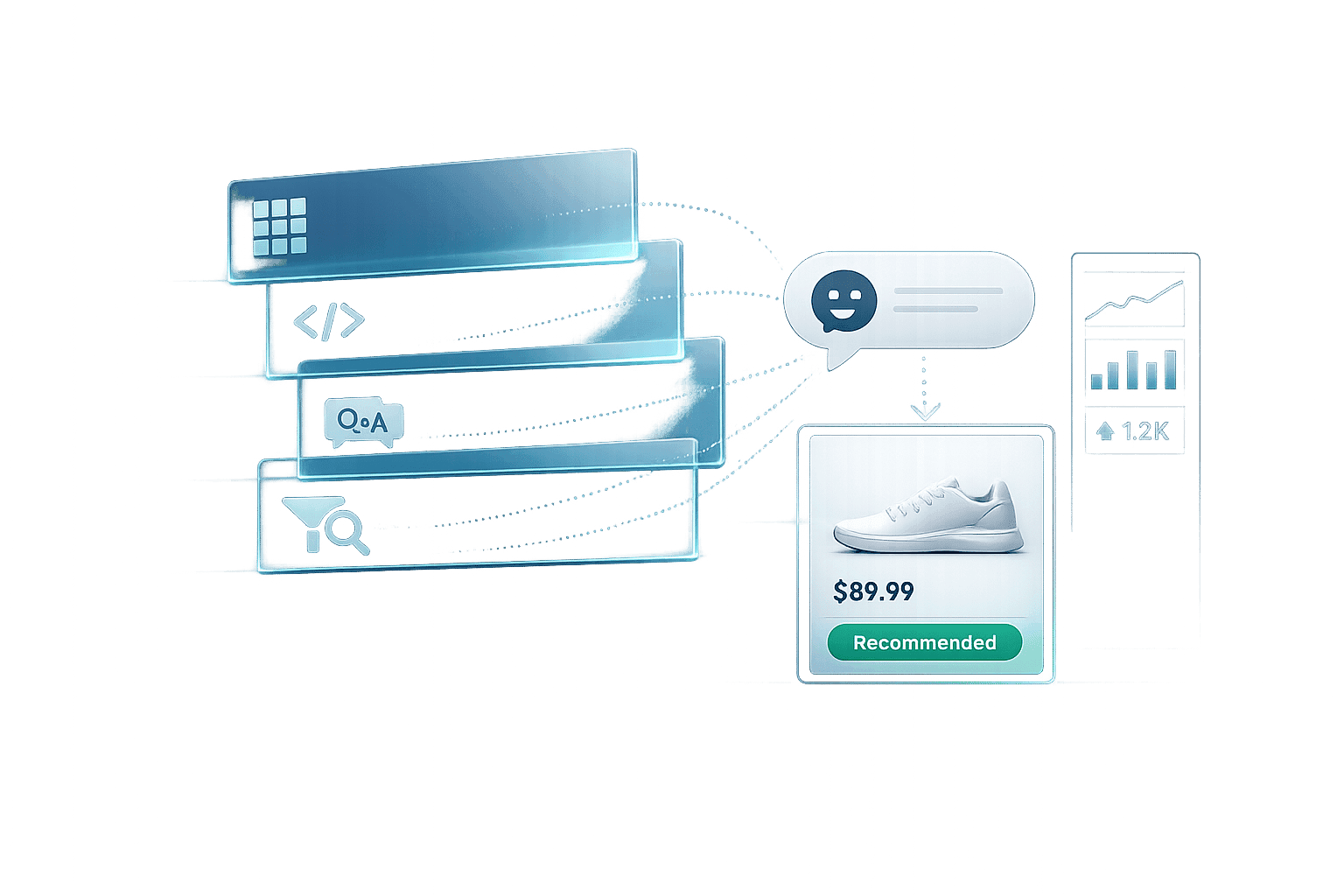
Consumers are increasingly relying on AI platforms like ChatGPT, Perplexity, and Gemini for product recommendations instead of traditional search engines. By late 2025, these AI tools accounted for 5.6% of search traffic, with usage doubling every two months in 2024–2025. To ensure your brand is visible in this new landscape, focus on creating content that AI platforms can easily understand and recommend. Here's how:
Be precise and consistent: Use clear product names and verifiable data points to improve trust and accuracy.
Optimize technical metadata: Add schema markup (e.g., Product, FAQPage) and ensure your site is crawler-friendly for AI bots like GPTBot.
Focus on high-intent queries: Address detailed, decision-driven questions that shoppers ask AI tools.
Structure content for AI: Use Q&A formats, detailed product descriptions, and comparison tables with rich metadata.
Track and adjust: Tools like MentionOS help monitor your brand's visibility in AI recommendations and identify gaps.
AI-driven product discovery is reshaping e-commerce. If your content isn’t AI-ready, your brand risks being overlooked. Start optimizing now to stay ahead.
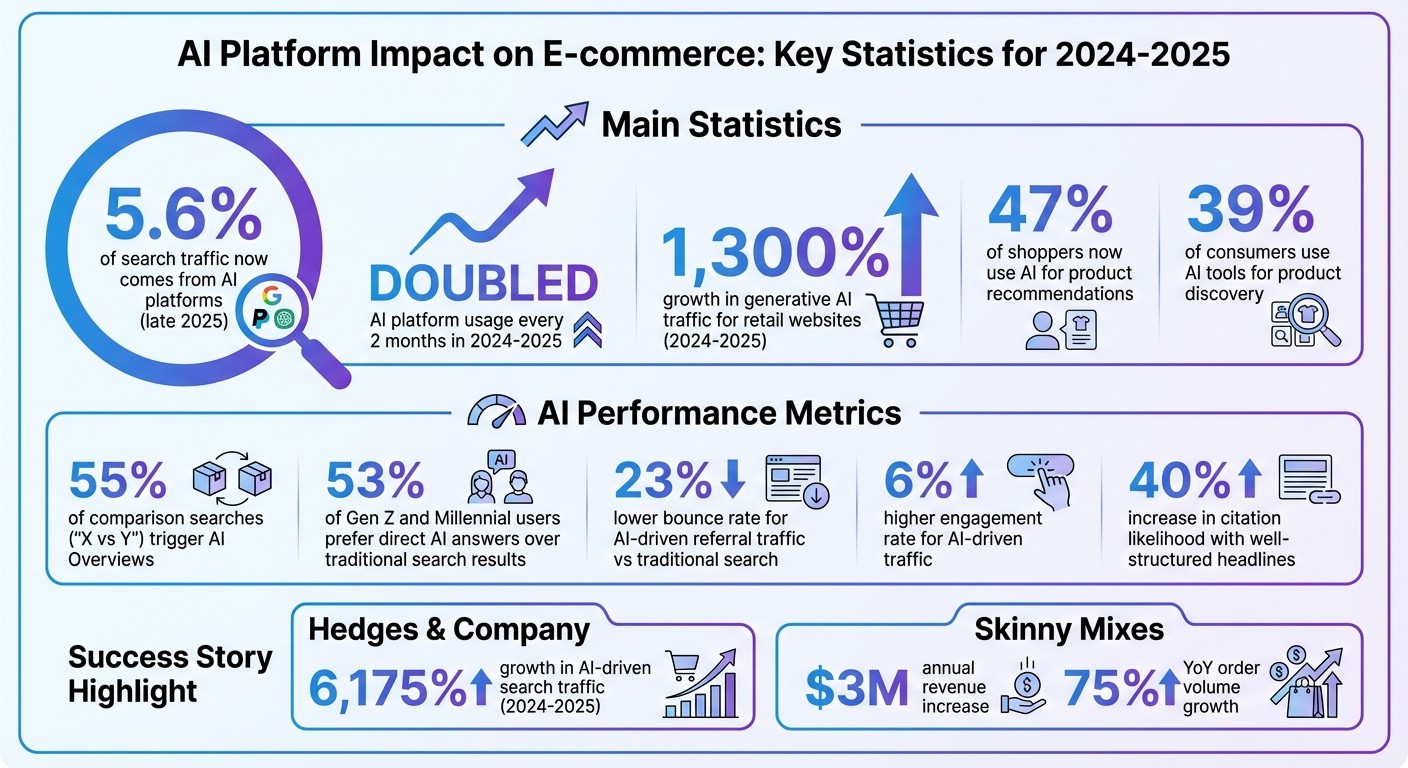
AI Platform Impact on E-commerce: Key Statistics for 2024-2025
How AI Platforms Choose What to Recommend
What AI Algorithms Look For
AI platforms don’t just skim through content - they assess its reliability for use in conversations. Their decisions hinge on three main factors: entity alignment, factual density, and technical metadata.
Entity alignment ensures your brand, products, and key figures are consistently identified across the web. For instance, if your product is called "UltraComfort Pro Mattress" on your website but listed as "UltraComfort Mattress Pro" on Amazon, AI systems may find it difficult to verify the correct version. This inconsistency can weaken your brand’s representation in AI knowledge graphs [9][2].
Factual density separates meaningful content from marketing fluff. AI models prioritize precise data points - like "14-hour battery life" or "launched in Q4 2024" - over vague statements such as "industry-leading" or "best-in-class." Tanatswa Chingwe, a B2B SaaS copywriter, emphasizes that concise, precise writing helps brands become more trustworthy sources for AI recommendations [9]. Replace hype with specific, verifiable details to strengthen your content’s credibility.
Technical metadata gives AI the context it needs to understand your products. Schema markup, particularly types like Product, FAQPage, HowTo, and ProductGroup, provides machine-readable data about what you sell, including pricing and availability [5][10][2].
Another key strategy is answer-first formatting - starting each section with a 2–3 sentence direct answer before diving into the details. This approach helps AI extract information more efficiently [9][2].
Once content meets these criteria, AI platforms place higher priority on material that addresses specific user needs.
Why High-Intent Queries Matter
AI doesn’t treat all searches equally. High-intent queries - like "What’s the best feeder for two cats and a dog if I forget meals?" - indicate a user is ready to make a decision. These queries often include constraints, such as budget, use case, or household size, which AI uses to compile a list of matching products [7].
If your product metadata doesn’t explicitly highlight attributes like "automatic", "multi-pet", or "scheduled feeding", your brand might not even appear on the AI’s radar. As Mention Network explains:
AI prompts are more intent-rich than keywords. A query like 'automatic dog feeder' is broad, but 'What is the best feeder for two cats and a dog if I forget meals?' is a decision query [7].
High-intent queries also frequently trigger AI Overviews. For example, comparison searches (e.g., "X vs Y") generate AI-powered answers 55% of the time, creating a prime opportunity for ecommerce brands to gain visibility [10]. Additionally, 53% of Gen Z and Millennial users now prefer direct AI answers over scrolling through traditional search results [9]. For Shopify brands looking to stand out in AI-driven storefronts, optimizing content to address these queries is critical. Without clear, complete answers to these questions, your products risk being overlooked by this growing audience of online shoppers.
Content Formats That Work for AI
The way your content is structured plays a huge role in whether AI platforms recommend it. AI favors content that’s easy to extract, verify, and integrate into responses. Three formats consistently perform well: Q&A structures, benefit-driven product descriptions, and schema-enriched comparison tables.
Q&A structures mimic natural conversations with AI assistants. Formatting your content as questions and answers - especially when paired with FAQPage schema - prepares it for easy citation. To align with real-world prompts, source questions from platforms like Reddit, support tickets, or "People Also Ask" sections [5][9].
Benefit-driven product descriptions replace generic marketing terms with specific, measurable details. For example, instead of saying "premium materials", specify "100% organic cotton, GOTS-certified." Similarly, swap "long-lasting battery" for "14-hour battery life on a single charge." This level of detail helps AI understand exactly why your product fits a particular query [1][7].
Comparison tables clarify decision-making by presenting structured data. A table comparing features like height range, weight capacity, and price for three standing desks, for instance, equips AI to match products to specific user needs [10][8].
Microsoft/Bing highlights the importance of structured data:
[Structured data] makes it easier for search engines not only to index your content, but to surface it accurately and richly in search results, shopping experiences, and AI-driven assistants [6].
For Shopify brands, combining these content formats with proper schema markup creates material that AI platforms can confidently recommend, boosting your visibility in the growing world of AI-powered storefronts.
How to Create AI-Optimized Content for Shopify

Finding High-Impact Keywords for AI
The old approach of relying on search volume for keyword research is outdated. AI platforms now prioritize intent-driven strategies that align with the context and goals of a user's conversational prompts [11]. Instead of aiming for broad terms like "standing desk", go after more specific queries like "What is the best standing desk for a small home office under $500?"
To uncover these conversational keywords, tap into sources like "People Also Ask", Reddit threads, Quora discussions, and customer support tickets. These platforms often reveal multi-part questions that include details like budget constraints, use cases, or household specifics [2].
Organize these queries into four main intent categories: Informational (e.g., "How does noise-canceling technology work?"), Navigational (e.g., "Where can I find Sony headphones?"), Commercial (e.g., "Sony WH-1000XM6 vs Bose QC Ultra"), and Transactional (e.g., "Buy Merrell Moab 3 hiking boots") [11]. Each type of query requires tailored content and detailed product metadata to meet user needs effectively.
Focus on entity-first targeting. AI prefers specific entities like products, brands, or categories. To align with this, structure your keywords to highlight the main entity upfront. For example, use a format like "[Product Category]: [Action/Outcome] for [Audience]" - think "CRM Platform: Pipeline Management for B2B SaaS" [12]. This approach helps AI quickly assess the relevance of your content.
Comparison queries are particularly powerful. Searches like "X vs Y" trigger AI Overviews 55% of the time, making them a goldmine for ecommerce brands [10]. If your Shopify store sells hiking boots, for instance, create content around "Merrell Moab 3 vs Salomon X Ultra 4" instead of just targeting "best hiking boots."
To monitor your performance, tools like MentionOS can track your "AI Impression Share" across platforms like ChatGPT, Perplexity, and Gemini. These tools help identify gaps where competitors are being cited for high-intent queries but your brand is not [2]. As Mention Network puts it:
The era of targeting keywords for volume is over, the era of architecting content for citation based on precise, conversational prompts has begun [11].
Once you've identified the right keywords, the next step is to format your content so AI platforms can extract it seamlessly.
Formatting Content for AI Readability
AI platforms rely on how your content is structured to determine whether it’s worth citing. To make your content AI-friendly, focus on three key principles: semantic HTML structure, entity-rich metadata, and an answer-first organization.
Use a clear headline hierarchy (H2, H3, H4) to break your content into logical sections. Well-structured headings increase the likelihood of being cited by AI engines by 40% [12]. Additionally, keep paragraphs short and easy to read, and use semantic HTML tables for product comparisons or specifications. For example, a table comparing battery life, weight capacity, and price for three standing desks can provide precise data points that match user queries [10].
For Shopify stores with product variants, use the ProductGroup schema instead of the basic Product schema. This helps AI crawlers understand that different options (like size or color) exist for the same product, reducing confusion in recommendations [5]. Adding an llms.txt file to your root directory with a brief brand description, key product categories, and links to important pages like FAQs can also improve AI visibility [4].
Optimize your images with descriptive filenames and alt text. Instead of generic filenames like IMG_1234.jpg, use something like womens-hiking-backpack-70L-sideview.jpg and include alt text that describes the product in context [5]. AI models increasingly analyze images alongside captions and filenames to gain a better understanding of your products [4].
Finally, ensure your robots.txt file allows AI-specific crawlers like GPTBot, ChatGPT-User, and PerplexityBot to access your content [2]. Blocking these crawlers can prevent your content from being included in AI recommendations. Proper formatting is essential for boosting your visibility and securing a spot in AI-driven storefronts.
Writing in a Conversational, Benefit-Focused Style
After structuring your content for AI readability, the next step is to write in a conversational tone that resonates with both users and AI systems. AI platforms favor factual, conversational content over promotional language. Focus on benefits rather than features, and write in a way that feels natural and engaging.
Start with an answer-first approach. Provide a concise, direct answer (two to three sentences) immediately under each heading, then expand with more details [7]. For example, if someone asks, "What's the best feeder for two cats and a dog if I forget meals?", you might respond: "Automatic feeders with multi-pet portions and programmable schedules work best for households with multiple animals. Look for models with at least a 12-cup capacity and separate compartments to prevent food guarding."
Highlight benefits over technical specs. Instead of saying "Adjustable height range: 28–48 inches", explain the value: "Adjustable height from 28 to 48 inches accommodates users from 5'2" to 6'4" for proper ergonomic positioning" [4]. Avoid using superlatives like "best-in-class" or "revolutionary", as AI models prioritize verifiable information [12].
Build a strong FAQ section using real customer questions from support tickets or "People Also Ask" queries [2]. Pair these FAQs with FAQPage schema, making it easier for AI to extract and present your answers.
A great example of this strategy in action comes from Skinny Mixes, a Shopify beverage brand. In early 2026, they used Webgility automation to streamline product data and emphasize operational efficiency - key trust signals for AI recommendation engines. The result? A $3 million increase in annual revenue and a 75% year-over-year rise in order volume [4]. As Yash Bodane, Senior Product & Content Manager at Webgility, explains:
Your product descriptions shouldn't just list features; they should answer the questions shoppers are asking AI tools [4].
Technical Steps to Improve AI Visibility
Adding Schema Markup and Rich Descriptions
Schema markup acts as the language AI platforms use to understand and cite your products [3][8]. For Shopify stores, the most important schemas include Product, Offer, AggregateRating, and FAQ. If you sell products with multiple variations - like t-shirts in different sizes or colors - opt for the ProductGroup schema instead of the basic Product schema. This helps AI crawlers recognize the different variations as part of a single product [5].
Make sure to include unique product identifiers like GTINs (Global Trade Item Numbers) and MPNs (Manufacturer Part Numbers) in your structured data. These identifiers help AI accurately match your products across various platforms and databases [5][13]. Embed your schema directly into static HTML instead of relying on JavaScript or tools like Google Tag Manager. As Tom van den Heuvel, CMO, points out:
AI systems cannot execute JavaScript. If your structured data is added via Google Tag Manager or client-side JavaScript, AI crawlers can't see it [15].
Adding AggregateRating and Review schema to your product pages is also key. AI models tend to favor products that are highly rated and widely reviewed when making recommendations [3][13]. Well-structured data can significantly increase your chances of being featured in AI-generated summaries or as a recommended source [15]. This isn't just about ranking - it’s about becoming the trusted name AI platforms cite in their answers [2].
Once your schema is optimized, the next step is ensuring your site performs flawlessly for AI crawlers.
Improving Site Performance for AI Crawlers
Site performance plays a huge role in how effectively AI crawlers can index and recommend your content. AI crawlers like GPTBot and ClaudeBot don’t process JavaScript, so all critical information - like product details, reviews, and pricing - must be available in the initial HTML response [15]. Using server-side rendering (SSR) ensures your content is accessible right away. Aim for page load times under 500ms, especially for mobile users, to improve AI indexing rates [15].
Another helpful step is creating an llms.txt file in your Shopify root directory. This file acts as a guide for AI crawlers, summarizing your brand identity, major product categories, and specific instructions - similar to how robots.txt works for traditional search engines [4][15]. Yash Bodane, Senior Product & Content Manager at Webgility, explains:
The llms.txt file is an emerging standard that helps AI crawlers understand your website. Similar to how robots.txt guides traditional search engine crawlers, llms.txt provides instructions and context specifically for LLM systems [4].
Make sure your robots.txt file allows access to AI-specific crawlers like GPTBot, ClaudeBot, and PerplexityBot [6][7]. Keep your URLs clean and indexable, and update your XML sitemaps regularly for both products and buying guides [3][7]. These technical adjustments ensure your store stays visible to the AI assistants shaping modern ecommerce decisions.
Between 2024 and 2025, Hedges & Company saw a staggering 6,175% growth in AI-driven search traffic by implementing robust schema markup, creating an llms.txt file, and switching to server-side rendering [15]. During the same period, generative AI traffic for retail websites grew by 1,300% [15].
Once your schema and site performance are optimized, the next step is monitoring your AI visibility with tools like MentionOS.
Using MentionOS to Monitor and Adjust
After laying the technical groundwork, it’s important to track how AI platforms are referencing your brand. MentionOS helps you monitor your AI Share of Voice across platforms like ChatGPT, Perplexity, and Gemini, showing exactly where and how your Shopify store is featured in AI-generated recommendations [2]. It also highlights high-impact queries where competitors are mentioned but your brand is absent, helping you identify content gaps to address.
MentionOS doesn’t just track mentions - it also evaluates how your brand is being described. If your citations drop while traditional search rankings remain steady - a phenomenon known as "LLM drift" - MentionOS alerts you to outdated information or missing entities that AI models might be skipping [14].
The platform’s Content Studio allows you to publish AI-optimized articles directly to your Shopify store. Additionally, its llms.txt customization feature ensures AI crawlers receive clear, accurate instructions about your products and brand. With tools to analyze historical data and advanced filters, MentionOS helps you refine your strategy over time by focusing on the content formats and topics that drive the most AI visibility.
AI-driven referral traffic tends to perform better than traditional search, with a 23% lower bounce rate and a 6% higher engagement rate - making these optimizations measurable in revenue terms [15].
Measuring and Improving AI Recommendation Performance
Tracking Your Brand Across AI Platforms
After establishing a solid technical foundation, the next step is figuring out where and how AI platforms recommend your brand. Unlike traditional SEO, AI recommendations shift constantly as models interpret queries differently over time. To stay ahead, focus on three key metrics: AI Impression Share (AIS), which tracks how often your brand shows up in AI-generated answers; Citation Frequency, which counts how often your domain is linked in responses; and Brand Sentiment Score, which evaluates whether AI describes your products in a positive or negative light [2][3].
Tools like MentionOS can help you monitor your brand’s presence across platforms like ChatGPT, Perplexity, and Gemini in real time. These tools show which queries mention your brand and, more importantly, which ones don’t - highlighting where competitors are being cited instead. Because AI outputs can vary with every query, it’s a good idea to test each query 3–5 times across platforms. This repetition helps you identify consistent trends rather than relying on one-off mentions [16].
By understanding these metrics, you'll be better equipped to pinpoint where your content might be falling short.
Finding Performance Gaps and Content Opportunities
One of the most valuable insights comes from identifying high-intent queries where your brand is missing. For instance, if a competitor is cited for "best yoga mats for hot yoga" and your brand isn’t mentioned, that’s a clear content gap you need to address. MentionOS helps uncover these opportunities by analyzing competitor mentions and highlighting areas where your product pages or guides lack the structured, concise content AI models prefer [2][17].
To stay proactive, build a prompt library from sources like customer support tickets, Reddit discussions, and Google’s People Also Ask sections. Test these prompts monthly to track changes in sentiment and competitor mentions [6][17]. If you notice a mismatch between impressions in Google Search Console and actual clicks, it could indicate that users are getting their answers directly from AI summaries - bypassing your site altogether [5].
These insights are invaluable for shaping your ongoing content strategy.
Updating Your Strategy Over Time
To maintain visibility in AI recommendations, your content needs to evolve continuously. AI models prioritize up-to-date information, so content that performed well in early 2025 could lose relevance by mid-2026 if left untouched. Plan quarterly content updates to refresh statistics, update links, and revise dated references (e.g., changing "Best Strategies for 2025" to "Best Strategies for 2026") [2]. Regular updates signal to AI crawlers that your content remains current and trustworthy.
Monitor server logs to track when AI crawlers like GPTBot, OAI-SearchBot, and PerplexityBot visit older product pages [6]. If you notice a drop in citations while your traditional rankings hold steady, it’s a sign that the information on those pages might be outdated [16]. MentionOS can alert you to such issues, allowing you to address them before they impact your AI visibility further.
Between 2024 and 2025, traffic to ecommerce sites from generative AI tools doubled every two months, with 47% of shoppers now turning to AI for product recommendations [4]. To stay competitive in this fast-evolving landscape, continuous monitoring and regular updates are essential.
Conclusion
Key Takeaways for Shopify Brands
AI assistants are rapidly replacing traditional search engines. With 39% of consumers now using AI tools for product discovery, optimizing your store for AI-driven recommendations is no longer optional [4].
"The future of organic traffic belongs to the authoritative source, not just the top-ranked page." – Mention Network [2]
To stay ahead, adopt an answer-first approach. Start your product pages with a clear, concise 2–3 sentence response to common customer questions. Use schema markup to make your content easier for AI crawlers to interpret [2][7]. Focus on conversational, long-tail queries that reflect how real shoppers phrase their searches. And don’t overlook the importance of maintaining consistent, accurate data across your Shopify store, marketplaces, and review platforms - AI favors brands that provide clean, verifiable information [3][4].
Building strong E-E-A-T (Experience, Expertise, Authoritativeness, Trustworthiness) signals is essential for shaping your brand’s narrative before customers even click. A great example is Skinny Mixes, a beverage brand that automated data synchronization across channels in 2025. This ensured consistent product information, a critical factor for AI trust. The result? They doubled their online revenue, adding over $3 million annually, with a 75% year-over-year increase in order volume [4].
These strategies align perfectly with how MentionOS equips Shopify stores for success in AI-driven commerce.
How MentionOS Prepares Your Store for Conversational Commerce
MentionOS shifts your focus from chasing traffic to owning your narrative. The platform tracks key metrics like AI Impression Share (AIS), Citation Frequency, and Brand Sentiment Score across platforms such as ChatGPT, Perplexity, and Google AI Overviews. This helps you pinpoint where your brand appears and identify gaps to address [2][7].
"Your invisibility is your competitor's citation." – Mention Network [2]
With AI platforms now capturing 5.6% of search traffic and influencing 47% of shopper recommendations, conversational commerce is quickly becoming the new storefront [5][4]. MentionOS enables you to measure, monitor, and optimize for this shift, transforming AI-driven discovery into a reliable and scalable revenue channel for your Shopify store.
How To Create and Optimise Your Content for AI Search
FAQs
What content changes make AI assistants recommend my Shopify products?
To have AI assistants recommend your Shopify products, make sure your product data is well-organized and easy for AI systems to interpret. Write clear, factual, and algorithm-friendly content that highlights key details. Publish this information on platforms trusted by AI models. Prioritize detailed product descriptions, customer reviews, and transparent policies to ensure AI can easily process and reference your content.
Which schema types matter most for AI product recommendations?
When it comes to AI-powered product recommendations, certain schema types play a crucial role in ensuring your products are accurately understood and displayed. These include:
Product schema: Covers essential details like the product's name, description, and specifications.
Review schema: Highlights customer feedback, including ratings and reviews.
Offer schema: Focuses on pricing, availability, and any discounts or promotions.
Breadcrumb schema: Provides context about your site's hierarchy, helping users and AI understand the product's location within your website.
If your structured data is incomplete or missing, AI systems may struggle to interpret your products effectively. Precise and comprehensive schema markup is key to improving visibility in AI-driven recommendations.
How can I track if AI platforms are citing my brand more over time?
Tracking your brand's presence in the AI space is easier with tools that monitor mentions and citations across platforms. Focus on reports that show how often your brand is referenced by systems like ChatGPT or Google AI. Pay attention to metrics like AI citation trends and visibility insights - these can reveal how frequently your brand is recommended and how that changes over time.
Related Blog Posts
Don’t let AI decide your visibility without you
AI search and chat tools are shaping what customers discover. MentionOS gives you clarity, insight, and control over how your brand is recommended.