Download App
AI Visibility Tracking: A Complete Guide for Brands
E-Commerce SEO
Feb 11, 2026
Measure and improve your brand’s visibility in AI assistants: track AI Share of Voice, sentiment, product data, and link mentions to Shopify revenue.
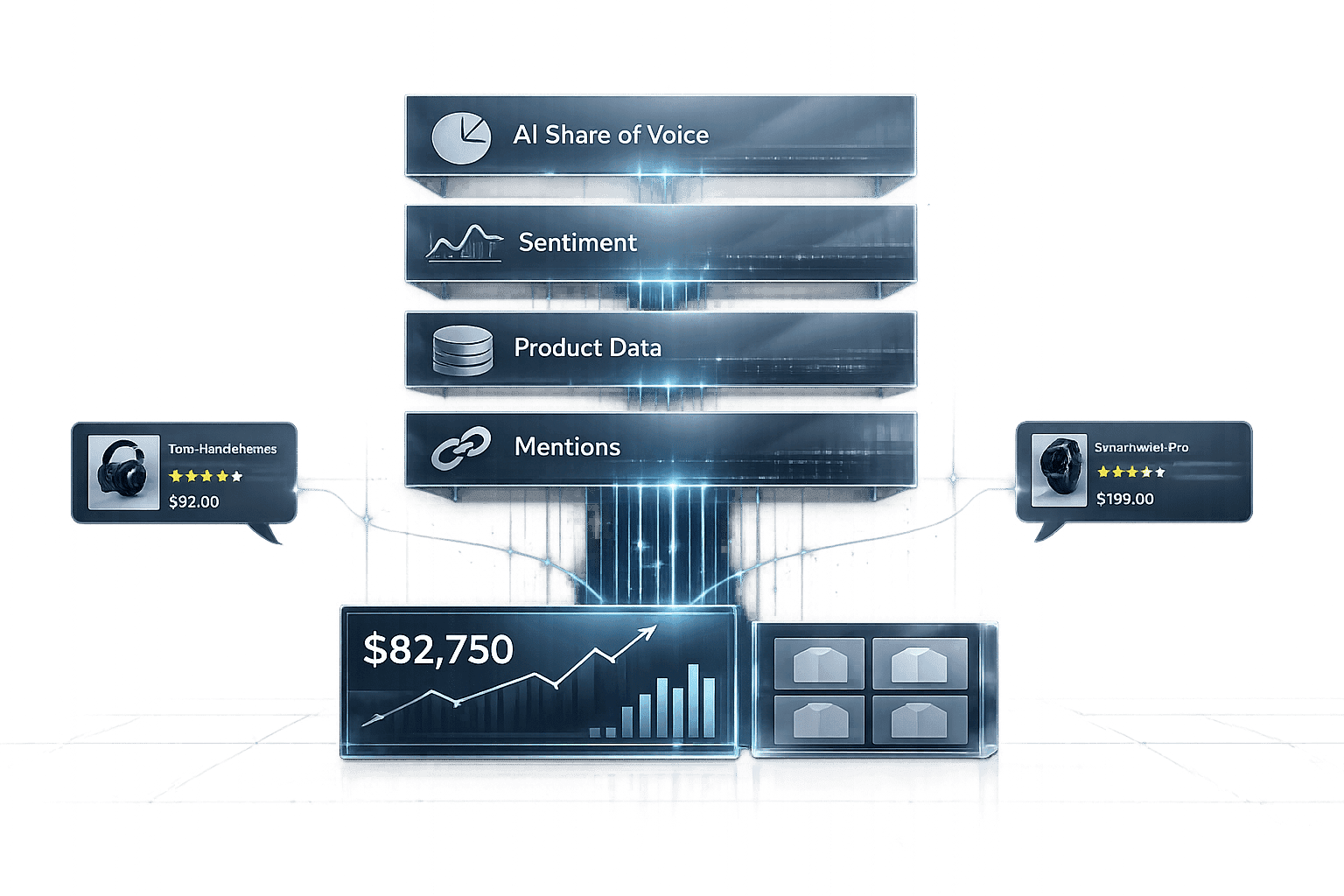
AI-driven shopping is reshaping how customers discover products. If your brand isn’t mentioned in AI-generated recommendations from tools like ChatGPT, Gemini, or Perplexity, you risk being invisible. Here’s what you need to know:
AI assistants now influence buying decisions with personalized, synthesized answers, replacing traditional search results.
Metrics like AI Share of Voice (SOV) measure how often your brand is mentioned compared to competitors.
Sentiment and position in AI answers matter - being the top recommendation or described positively can drive stronger brand perception.
Real-time product data (pricing, inventory) ensures AI systems recommend your products accurately.
Tools like MentionOS automate tracking, saving time and providing actionable insights to improve AI visibility.
With 65% of users starting product research with AI tools, optimizing your Shopify store for AI visibility is essential. This guide explains how to measure performance, improve your presence, and connect AI mentions to revenue growth.
AI SEO Strategy 2025: Track Brand Mentions in ChatGPT, Google AI & More
Key Metrics for Tracking AI Visibility
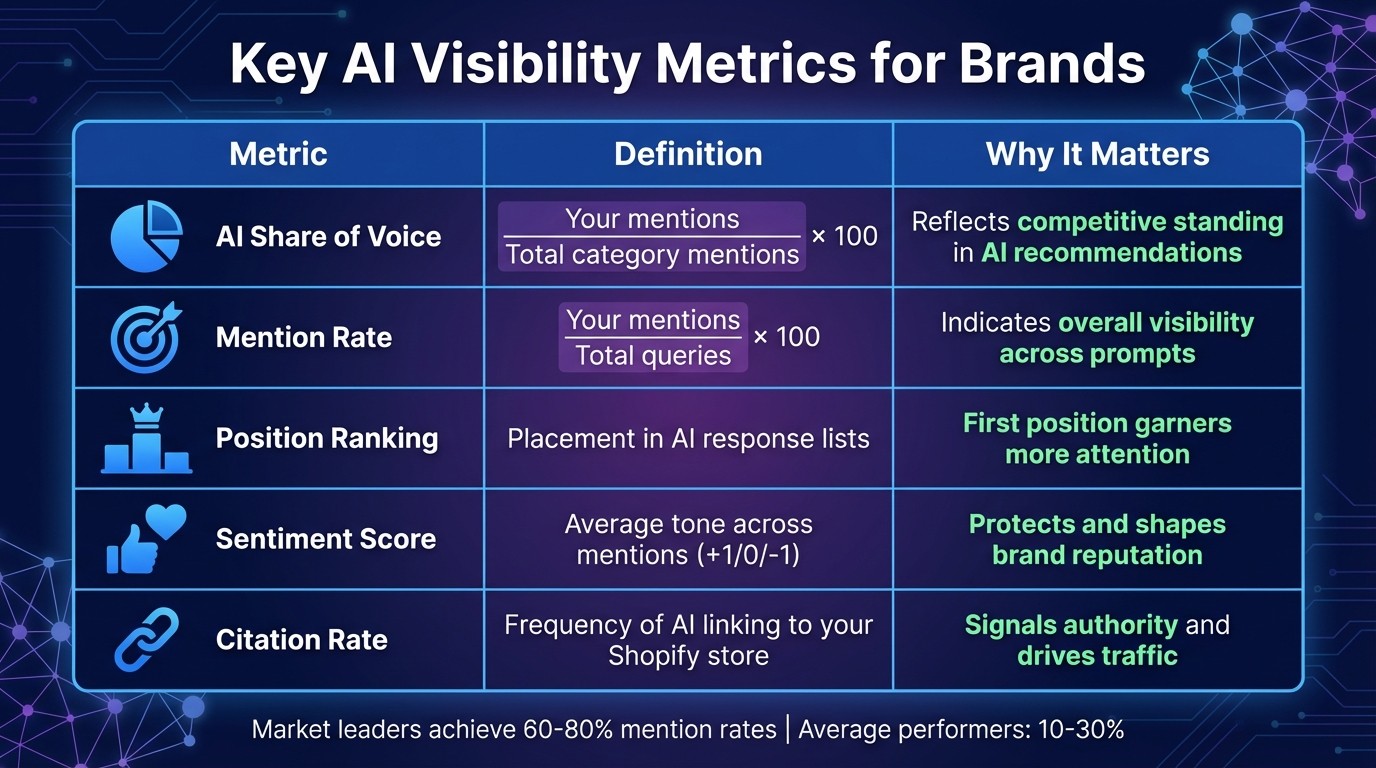
Key AI Visibility Metrics for Brands: Definitions and Impact
Tracking AI visibility involves understanding how often your brand is mentioned and the context in which it appears. The focus has shifted from simply earning clicks to maintaining credible mentions across the web [3].
One key metric to monitor is AI Share of Voice (SOV). This measures the percentage of AI-generated recommendations in your category that include your brand compared to your competitors [7][8]. You can calculate it using this formula:
(Your Brand Mentions / Total Mentions of All Brands) × 100 [10].
Market leaders tend to achieve a mention rate of 60-80% for category queries, while average performers hover around 10-30% [10]. Interestingly, marketing teams that effectively track these advanced metrics often secure 15% higher budgets [7][8].
Share of Voice in AI Recommendations
AI SOV highlights how often your brand surfaces in AI-generated responses to queries like "best organic skincare under $50" or "most durable hiking boots for winter." This metric is vital because:
"AI SOV measures mentions within the AI's own, authoritative-sounding answers. Because users often perceive these answers as more objective, AI SOV can have a more significant impact on brand perception" [7].
To establish your baseline, run 20-30 relevant queries across platforms like ChatGPT, Claude, Gemini, and Perplexity. Count how many times your brand appears compared to competitors. For example, if your brand is mentioned 15 times out of 50 relevant queries, your mention rate is 30%. If competitors collectively receive 100 mentions across the same queries and you receive 15, your SOV is 15%.
Only 30% of brands manage to maintain visibility in consecutive AI-generated answers, and just 20% sustain it across five consecutive runs [9].
Sentiment and Position in AI Responses
Where your brand appears in AI recommendations matters. Being the first recommendation carries more weight than appearing further down the list. Track your placement: first mention (primary recommendation), middle mention (among options), or last mention (alternative or afterthought) [10].
Sentiment tracking is equally important. Use a numerical system to assess tone objectively:
Assign +1 for positive mentions,
0 for neutral mentions,
-1 for negative mentions [6].
Pay attention to how AI platforms describe your products. Do they highlight strengths like "premium materials" and "excellent customer reviews", or drawbacks like "higher price point" and "limited availability"?
Monitor direct inquiries (e.g., "What do you know about [Your Brand]?"), competitive comparisons (e.g., "[Your Brand] vs [Competitor] for sensitive skin"), and problem-solution prompts (e.g., "How to find affordable organic skincare?") [6]. With over 60% of Google searches now including AI-generated answers [9], tracking sentiment is essential for protecting and enhancing your brand's reputation.
Brand Ranking for Product Queries
Building on SOV and sentiment insights, tracking brand ranking for product queries helps capture shopper intent during the consideration phase. High-intent product queries, like "best Shopify apps for SEO" or "top-rated standing desks for home offices", indicate shoppers ready to make a purchase.
To measure this, create a query library with:
Category queries (e.g., "Best [product type]"),
Use case queries (e.g., "What [product] for [specific need]?"), and
Comparison queries (e.g., "[Your Brand] vs [Competitor]").
Then compute your mention rate:
(Your Mentions / Total Queries) × 100 [10].
Accuracy is key for Generative Engine Optimization (GEO) [3]. Content updated within the last 12 months is 2× more likely to earn citations in AI responses, and pages with rich schema markup are 13% more likely to be cited [9].
Metric | Definition | Why It Matters |
|---|---|---|
AI Share of Voice | Your mentions / Total category mentions × 100 | Reflects competitive standing in AI recommendations |
Mention Rate | Your mentions / Total queries × 100 | Indicates overall visibility across prompts |
Position Ranking | Placement in AI response lists | First position garners more attention |
Sentiment Score | Average tone across mentions (+1/0/-1) | Protects and shapes brand reputation |
Citation Rate | Frequency of AI linking to your Shopify store | Signals authority and drives traffic |
Using proper heading structures (H1 > H2 > H3) can improve your chances of being cited by 2.8× [9]. The next section will explore how MentionOS simplifies this tracking process, saving data-driven marketing teams up to 10 hours per week [7][8].
How to Track AI Visibility with MentionOS
Manually tracking AI visibility with 20–30 prompts per platform can eat up about 10 hours every week just for reporting [7]. MentionOS eliminates this hassle by automating the process, delivering real-time insights across major AI platforms. Instead of relying on synthetic test prompts, it focuses on capturing actual user interactions [1].
MentionOS uses an AI Visibility Score, which is calculated based on four key metrics: Frequency (25%), Accuracy (30%), Sentiment (20%), and Share of AI Voice (25%) [3]. These metrics provide a clearer picture of your brand’s presence in AI recommendations. Beyond just knowing if your brand appears, the score reveals how accurately AI models describe your products and whether you're gaining an edge over competitors. This automated approach transforms raw data into actionable insights, making it easier to analyze trends and competitor performance.
Setting Up Tracked Prompts
MentionOS kicks off with custom onboarding to align tracking with your industry and competitive landscape [11]. It helps you configure prompts that cover a range of scenarios, including:
Category queries like "best Shopify apps for inventory management."
Comparison queries such as "Brand A vs. Brand B for sensitive skin."
Use-case queries like "What standing desk works for small apartments?"
The platform captures natural language patterns, including typos and specific constraints. For instance, if users often search for "affordable organic skincare under $30", MentionOS tracks whether your brand appears in those exact contexts. Pricing starts at $29/month for the Starter plan (5 prompts) and $49/month for the Growth plan (50 prompts), catering to different levels of need.
"Visibility becomes a yes-or-no outcome instead of a ranking battle. Users see only the brands the model chooses to include, making Brand mentions the new visibility currency." - Mention Network [1]
Monitoring Competitor Mentions
MentionOS doesn’t just track your brand - it also identifies which competitors show up alongside you in AI-generated answers and maps out competitive clusters [1][11]. This helps you understand what factors contribute to their recommendations. For example, if AI consistently groups your brand with lower-tier competitors, you’ll know which aspects of your structured data or content need improvement.
The platform also tracks citation sources, highlighting which domains AI models reference when mentioning your brand [11]. This insight is critical because only 12% of links cited by AI assistants appear in Google’s top 10 results for the same query, and 28% of ChatGPT’s most-cited pages have no Google visibility at all [4]. Essentially, you’re optimizing for the sources AI models trust, not just traditional search rankings.
Another useful feature is the Accuracy metric, which flags outdated or incorrect information. For example, if Gemini shows last year’s pricing while ChatGPT has the current data, MentionOS alerts you to fix the discrepancy [3]. By tracking these shifts and competitor trends, you can refine your Shopify store data to stay relevant in AI recommendations.
Looking beyond immediate competitor insights, historical data can provide a roadmap for long-term improvement.
Using Historical Data for Trend Analysis
Your first MentionOS report sets a baseline for future optimizations [7][8]. Since AI responses can be inconsistent and change frequently, historical data helps you focus on directional trends instead of reacting to one-off anomalies [13].
Brands that consistently monitor and refine their AI mentions have reported up to a 40% increase in citation share within a year [13]. Long-term tracking uncovers seasonal patterns and highlights the impact of major content initiatives, which short-term audits often miss [12]. For example, if you update Shopify product data or publish a new blog post, tracking the historical mention rate over the following weeks can reveal which efforts actually improve AI visibility.
"The real value of automated monitoring emerges over months, not days. Tracking mention trends over time reveals seasonal patterns, the impact of major content initiatives, and gradual improvements from sustained optimization." - Sight AI [12]
Historical data also exposes untapped opportunities - query categories where no competitor dominates AI recommendations [12]. For instance, if your Share of AI Voice (SAIV) grows from 15% to 28% over three months while a competitor’s drops by 20%, it means you’re gaining ground before they even realize it [13]. Additionally, marketing teams that effectively track and report on these advanced metrics often secure 15% higher budgets [7][8].
How to Improve Your Shopify Store's AI Visibility

To stay competitive in an AI-driven marketplace, keeping your Shopify store optimized for visibility is crucial. AI systems today prioritize structured, accurate, and up-to-date product data over vague marketing copy. If your product pages rely on outdated descriptions or incomplete schema, you risk being overlooked. By refining your data and content, you can ensure AI systems recommend your products effectively, driving sales and maintaining relevance.
Structure Product Data for AI Systems
AI systems thrive on precision. To make your products stand out, include identifiers like GTIN, Brand, and Manufacturer Part Number (MPN) in your Shopify product data [16]. Apply schemas such as Product, Offer, FAQPage, HowTo, and Review across your store to ensure AI systems can interpret and recommend your items [15][5]. For instance, if you sell standing desks, provide exact details like dimensions, weight capacity, and shipping limitations - don’t rely on generic marketing language.
Crafting effective product titles is another key step. Instead of vague descriptions like "Premium Standing Desk", go for something more specific: "Professional-grade standing desk for home offices, 40% quieter than standard models" [14][16]. Also, check your robots.txt file to ensure you’re not unintentionally blocking important crawlers like GPTBot, Google-Extended, or PerplexityBot [15].
Another helpful addition is a "What We Are" page. This serves as a clear, concise product overview that AI models can use as a reliable reference.
"GEO aligns your ground truth with AI so that generative engines describe you accurately, recommend you reliably, and cite you visibly." - Senso.ai [2]
Create Content Optimized for AI Platforms
AI platforms favor content that provides clear, direct answers right after a heading. Using an "answer-first" approach - starting with a brief, 2–3 sentence response before diving into details - makes it easier for AI systems to extract and cite your key points [15][2]. For example, you might write: "A basic skincare routine requires three steps: cleanser, moisturizer, and SPF," before elaborating further.
Use question-based headings to make your content more engaging and AI-friendly. For example, instead of a generic heading like "Product Features", try something like "What makes this moisturizer different from drugstore brands?" [5][15]. Tools like MentionOS Content Studio can help Shopify brands create AI-ready content by ensuring consistency across platforms.
It’s also important to keep your content fresh. Update high-impact pages quarterly to reflect the latest "last updated" dates, verify statistics, and ensure pricing aligns with your Shopify admin. These updates help maintain credibility in AI-generated summaries.
Feature | Traditional SEO | AI Search Optimization |
|---|---|---|
Primary Goal | Top 10 rank on a keyword SERP | Citation or recommendation in AI answers |
Target Query | Short-tail, transactional keywords | Conversational, multi-part prompts |
Content Structure | Hierarchical, topic-focused pages | Modular, answer-first sections |
Key Metric | Organic clicks and impressions | AI impression share and citation frequency |
Keeping your data and content aligned with AI preferences ensures better visibility and relevance.
Connect Live Inventory and Pricing Data
Real-time data integration is essential for maintaining accuracy in AI-powered recommendations. API integrations that sync live inventory and pricing data allow AI assistants to provide precise information. Instead of vague responses like, "Brand X might have this in stock," an AI assistant can say, "Brand X has 12 units available, ships in 2 days" [17]. This level of detail builds trust and increases conversions.
AI systems constantly reshuffle their answers, so outdated product pages can quickly lose prominence. Automated workflows that update your Shopify inventory and pricing in real-time help prevent this issue. For example, during flash sales or price adjustments, ensuring AI systems have the latest data is critical.
Live pricing data also plays a role in helping AI systems categorize your products correctly. If a shopper asks, "What's the best organic skincare under $30?" and your pricing isn’t up-to-date, your products might not appear in the results [1]. Tools like the Agentic Commerce Protocol (ACP) can help provide AI systems with real-time inventory and shipping information [17].
"Accurate data drives conversions. It's the difference between an AI assistant saying 'Brand X might have this in stock' versus 'Brand X has 12 units available, ships in 2 days.'" - Adam Edwards & Travis Tallent, Brainlabs [17]
Regularly review AI-generated summaries of your brand to catch errors like outdated pricing or misrepresented features. Keeping your data current ensures AI assistants consistently recommend your products, positioning your brand as a trusted choice in the AI-driven shopping landscape.
Connecting AI Visibility to Revenue
Tracking AI visibility goes beyond counting mentions - it’s about tying those mentions directly to revenue. For Shopify brands, this means isolating AI-driven traffic in analytics and linking it to sales performance. To accomplish this, set up custom GA4 channel groups to track referrals from platforms like chat.openai.com, perplexity.ai, and gemini.google.com [9][18]. These steps create a foundation for aligning AI visibility with revenue outcomes.
Tracking Traffic from AI Recommendations
Using UTM parameters for AI-driven campaigns is key. These parameters allow you to monitor sessions and conversions that originate from AI-generated responses [9][18]. To estimate reach, divide AI-driven traffic by the typical 2% click-through rate (CTR). For example, 100 visitors would suggest roughly 5,000 impressions.
Alongside direct traffic, it’s important to track assisted conversions to understand how AI visibility impacts the middle of the funnel. Research shows that 65% of users now start their product searches with AI tools instead of traditional search engines [18]. This highlights how AI-driven discovery often serves as an essential touchpoint in the customer journey, even if it doesn’t immediately lead to a purchase. Additionally, brands should evaluate lead quality by analyzing whether prospects who mention AI research during discovery calls have higher win rates or shorter sales cycles [18].
But tracking traffic is just one piece of the puzzle - understanding the broader ecommerce impact of AI recommendations is equally important.
Ecommerce Metrics Affected by AI Visibility
AI visibility significantly impacts core ecommerce metrics. For instance, tracking conversion rates by source can reveal how visitors from AI recommendations perform compared to those from search engines or social platforms [18]. Another important metric is the citation rate - the percentage of AI mentions that include a clickable link back to your Shopify store. Securing both a mention and a citation can boost ongoing visibility by as much as 40% [9].
One more advanced metric is Share of AI Voice (SAIV), which measures your brand’s percentage of mentions within a product category compared to competitors [3][18]. Think of it as the market share for the AI era. Interestingly, marketing teams that track and report on these advanced metrics often see a 15% higher budget allocation than teams that don’t [7].
"With AI search, there are only two funnel stages: educational and transactional. The goal is for the LLM to cite your brand, then people come to your site to buy." - Patrick Reinhart, VP, Services and Thought Leadership, Conductor [18]
Building Custom Reports with MentionOS
MentionOS simplifies the process of connecting AI visibility to revenue growth. By automating key metrics, it provides a strategic edge in the AI-driven marketplace. MentionOS aggregates anonymized data from platforms like ChatGPT, Gemini, Claude, and Perplexity to create an AI Visibility Report. This report includes metrics like frequency, accuracy, sentiment, and share of voice, eliminating the need for manual tracking [1][3][7].
Custom dashboards in MentionOS allow you to map brand mentions against contextual relevance, helping identify which AI-driven recommendations bring high-intent shoppers to your store [1][3]. The platform also offers export tools, enabling you to create tailored reports that link visibility improvements to revenue growth. Before diving into optimization, it’s crucial to establish a "Day Zero" benchmark, capturing current mention rates, sentiment, and share of voice to measure future ROI [10]. Professional plans start at $79/month and include export and API access for seamless integration with your existing analytics tools.
Conclusion
AI assistants are reshaping how customers discover products. With 83% of people favoring AI-powered searches over traditional search engines and 65% starting their product research with AI tools instead of Google, this shift is no longer hypothetical - it’s happening now [20][18]. For Shopify brands, staying visible means being part of AI’s synthesized answers; otherwise, you risk being invisible.
This change is also driving measurable revenue impacts. For instance, ChatGPT referral traffic converts at 3.6%, generating an impressive $33.00 per session compared to just $8.50 for typical traffic. By 2027–2028, billions in commerce are expected to flow through AI-driven searches [19][22]. These AI-referred visitors are not casual browsers - they’re high-intent shoppers already vetted by the algorithms.
However, traditional analytics tools fall short when it comes to tracking in-AI interactions. Currently, only 16% of brands systematically monitor their performance in AI searches, leaving a massive opportunity for early adopters [23]. Tools like MentionOS are stepping in to fill this gap. MentionOS monitors brand mentions across platforms like ChatGPT, Gemini, Claude, and Perplexity, providing insights into metrics like frequency, sentiment, share of voice, and competitor performance. More importantly, it offers actionable steps to improve your brand’s position in AI-driven product discovery.
As discussed earlier, refining your presence in AI-generated responses is no longer optional - it’s a necessity for driving revenue in today’s digital landscape. Much like the early adopters of SEO gained a significant edge, Shopify brands that embrace conversational commerce now are positioning themselves to dominate as AI platforms continue to evolve [21]. Using MentionOS to optimize your AI visibility ensures your store stays ahead of shifting consumer behaviors. The real question isn’t whether you should track AI visibility - it’s whether you can afford not to.
FAQs
What’s the best way to measure AI Share of Voice for my Shopify brand?
To gauge AI Share of Voice for your Shopify brand, keep an eye on how frequently and in what context your brand shows up in AI-generated responses. Key metrics to monitor include brand mentions, citations, and overall recognition. Leverage tools that allow you to measure visibility across different AI platforms, compare your performance against competitors, and pinpoint areas where you're falling short. By fine-tuning your content for AI recommendations, you increase the chances of your brand being highlighted and reused, keeping you ahead in the world of conversational commerce.
How can I improve my brand’s rank and sentiment in AI recommendations?
To improve your brand's presence and reputation in AI-driven recommendations, prioritize AI visibility by creating high-quality, authoritative content and optimizing your technical setup. Include structured data - such as product details, reviews, and schema markup - on your site to help AI systems identify and reference your brand accurately. Keep a close eye on metrics like mentions and sentiment to fine-tune your approach. Additionally, adopting an answer-first content strategy can establish your brand as a reliable resource for AI systems.
How do I attribute AI mentions to revenue in GA4?
To connect mentions of AI to revenue in GA4, you'll need to establish custom tracking and attribution models. Start by using filters, segments, and custom reports to pinpoint AI-driven traffic sources and tie them directly to conversion data. Once you've gathered this information, dive into the analytics to see how AI-related traffic impacts sales or other key performance indicators. The goal here is to uncover actionable insights that can help you fine-tune and improve your overall performance.
Related Blog Posts
Don’t let AI decide your visibility without you
AI search and chat tools are shaping what customers discover. MentionOS gives you clarity, insight, and control over how your brand is recommended.